Team’s Status Report for 4/25

The most significant risks that could jeopardize the success of this project would be our inability to tune the motor controllers correctly so that they can properly give the right instructions to the motors themselves. We’re currently working on this portion of the project, and once that’s done, we should mostly be done with the project, apart from incorporating the audio component to handle pivoting to the designated actor after the previous actor’s dialogue is completed. Once that is done, we’ll be ready for the TechSpark demo along with the final demo, and we’ll also be able to meet on Thursday with Dr. Dueck and the School of Music for our demo with them for the “Ah Perdona” piece. Apart from that, we will of course also be working on the final report and the final video so that we can submit all of them in time when they are due.

On the audio side, the main tests that we performed were calculating the WER for the ASR system, specifically for the trigger phrases rather than the whole dialogue. We realized that it didn’t make sense to track the whole dialogue by each speaker, rather it would improve processing and accuracy if we only focused on the few words before the next actor’s part began. What we found was that the system was very accurate, with a 7% WER (10% is high-quality) on these trigger phrases, and that the trigger was almost always correctly initiated. However, the fact that it wasn’t perfect concerned us slightly, which is why we included a manual override button in the UI that allowed the director to control the cueing themselves in case the trigger didn’t work. On the tracking side, the main tests we performed were calculating the difference between the ground truth and the predictions by the UI, and we discovered that the accuracy was even better than we expected, allowing us to stick with our current design. On the overall system side, we tested the reliability of the entire system, and we confirmed that the nodes and other components all ran for at least 4 hours, which was what we were hoping for.

Team Status Report for 04/18/2026

The only obstacle/risk that’s present on the audio side has to do with the opera portion and the different tempos present in one of the pieces. To mitigate this, we’ll have to contact Professor Dannenberg and get his advice on how to deal with the multiple tempos using Accomplice. Apart from that, the only other obstacle is going through the blocking to figure out where the cues need to be set in the .gro file, but we’ll again communicate with Dr. Dueck and her students figured this out. The biggest obstacle regarding the physical tracking system for Autocam seems to be regarding the feedback loop for the rail. Accurately measuring the position of the trucking could be simultaneously affected by slipping belts, added friction, or even a bearing slightly losing contact with the aluminium pipe. These minute changes in variables could cause the system to be inaccurate when measuring the distance traveled across the x-axis. We aim to minimize these risks by consolidating the rail system and fine tuning and physical issues we encounter. Our mitigation methods include rebalancing the physical rail, use locktite for bearing connections, and re-tightening our trucking belt.  We got the trucking part of the Autocam working and live tracking a node this week! Please see our github for more details which we hope and are designing to allow any one in the future to improve upon and create our system with detailed instructions, (GitHub).

Team Status Report for 04/04/2026

The most significant risk related to the audio portion of the project is the consistency and reliability of Accomplice. While it’s been working for the most part through my testing, there’s been an issue with receiving OSC messages (mentioned more in individual reports) that should be fixed soon by Professor Dannenberg. Although this challenge should be addressed presently, there’s a worry that other issues could pop up in a variety of circumstances, and we’d have to prepare and solve each of them. This shouldn’t be impossible, but it might be difficult and annoying, especially because we wouldn’t know if it’s an issue on our side or in the Accomplice software unless we check in with Professor Dannenberg continuously. Another possible risk we have is that the VESC motor controller we’re currently using had one of its micro-usb ports for communication break off, so we’ll try to solder it back on. If that fails, we plan on trying to use the UART communication ports with the GPIO pins to control. We also had one of our printed parts for the rail system break recently, which delayed our assembly by a bit. To counteract this, we plan on printing extra parts for high strain areas of our design to ensure that if any future parts break, we’ll have a quick way to replace them and get back to testing/building.


One minor change that was made to the design of the audio system was the usage of a USB-B to USB-C adapter instead of the predetermined MIDI interface for connecting the MIDI keyboard to the Mac. Our idea is to have a RPi 5 connect to the keyboard and send cues to the central Pi, and so we will check that the USB-C port on the RPi keyboard can be used for a non-powering purpose. If this doesn’t work, we’d have to purchase an adapter from USB-B to a different USB type that’s available on the RPi. This causes one of the nodes to be used as a middle communication device as it’ll provide key information for the AutoCam system to change scenes. This upcoming week we hope to finalize the hardware integration of the AutoCam. As we finalize the hardware integration, we can bring all the systems together. From the audio cue system to the UWB tracking system. We will utilize both systems to finalize the motor controller software. This will be specifically done through the mathematical work of homography. For validation, we look to confirm the durability and the consistency of our product. We will be running the entire system at expected workloads to determine that it can work accurately for the full length of an opera or a theater performance. Each subsystem’s accuracy will be vetted thoroughly, and descriptions have been included in the individual reports. Validation testing will be done to measure the latency between the completion of the performer’s dialogue, the triggering of the cue, and the actual movement of the motors, which can then be used to optimize and minimize the time required. Additionally, final UWB accuracy testing will be performed from ground truth location to the filtered estimated location of the node. Finally, we will be testing the waterproofing nature of our wearable components and ensure that they are wearable and durable based on survey feedback from the performers and stress testing with water at different intensities. Noise levels will also be measured to ensure that our design won’t be overpowering the important audio in either the opera performances or stageplays. We’ll be spending the next couple weeks working with the opera students to ensure that our system meets their needs and fine tuning our subsystem integration.

Team Status Report for 03/28/2026

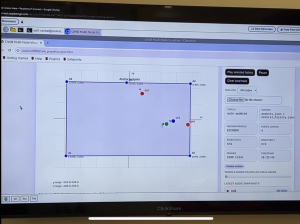
On the audio side, there are 2 significant risks, one related to the opera (music-based) portion and one related to the play (speech-based) portion. On the opera side, we need to ensure that the equipment that we’ll be using to obtain the MIDI recording is compatible with the off-the-shelf software that Professor Dannenberg designed. On the speech side, while Vosk is working pretty well with a single microphone, it remains to be seen how the performance will be with multiple actors, especially performers who are close to each other. There’s a worry that the interference caused by the audio being heard on multiple microphones could confuse Vosk and thus, mess up the processing and cue engine. This week allowed for major improvements to the tracking system overall. New firmware, updated software, and increased polling rate to the UWB sensors has allowed considerable system improvements. The central RPI 5 has also been configured to handle all processing needs offloading load from the four wearable nodes. The centralized system will allow seamless integration with our motors, CV camera, and audio cues. Communication from the wearable nodes has also been configured which will allow us to quickly send audio cues to the central pi to adjust the camera as necessary. Having this centralized system all communication goes to reliably initiates our full project implementation. Regarding the opera portion, a significant change has been made to the design, in that we’re now using an off-the-shelf system that was created by Professor Dannenberg. This software is based on MIDI files, and it enables high performance regardless of the presence of other performers and their vocalization. Our group is currently on schedule, as we look to complete the rail design by the end of the week and finish the audio and tracking subsystems too. We’ll look to integrate these different systems together in the coming weeks as our entire project comes together. There haven’t been any changes to our schedule.


4 Node Tracking


Team Status Report for 03/21/2026

The ability of the UWB anchors to work continuously over the duration of the play is something we have to test thoroughly; during our Saturday work session, we’ve had problems with the anchors turning off due to slightly incorrect resistor values. Although we’ve now gotten them all to run properly, we’ll have to do more stress testing to ensure that they are capable of recording a full play with no problems. Another risk that we have regarding the audio portion of the project is the presence of multiple instruments and the operatic dialogue that could cause interference with the piano music that is necessary for the Matchmaker library. We’ll have to discuss the scope of the project with Dr. Dueck and understand the exact use case, ensuring that we’re using the right tools. The plan to mitigate this is to use a powerful Samson microphone solely for the piano, as opposed to the Lavalier microphones we initially were using for each actor’s dialogue. Another risk we have is the motor VESC wiring. We’re currently connecting the motor phase wires to the VESC through just solder and e tape, and we run the risk of the connections breaking/shorting if they become a stress point during rail movement. We’re planning to mitigate these risks by later replacing the E tape with heat shrink for a more secure connection. In terms of schedule, we’re working on most systems concurrently. The UWB sensors/anchors should be up and running very soon, and once the ECE pick-up center is open, every part needed will be in our possession.

Team Status Report for 03/14/2026

This week productivity revolved around the team receiving the equipment we needed and meeting again with Dr. Dueck. Our meeting this week with Dr. Dueck where we showcased the design behind the tracking sensors. This demonstration provided the opera performers some insight into the sizing of the equipment to help them with outfit coordination. The meeting was overall successful with continued discussion on script cues and camera operation. Additionally, a novel proposition was introduced to utilize the piano’s audio as a way for the AutoCam to follow script position. Pareekshith received the Lavalier microphones, and after discussion with Dr. Dueck decided that it might be better to track the sheet music rather than the performer’s speech, especially given that it might be hard for Vosk to understand operatic dialogue. The design might change for this reason, and so we might end up having a single microphone next to the piano to get clear audio of the sheet music rather than having each actor with a clip-on microphone. Ahmad’s UWB sensors, battery packs, and RPI 5s have also arrived this week and he has begun testing and integration. Due to the auto shutoff from the battery packs, the UWB sensors will have to be manually connected with additional resistors to draw more current. The software is working well on the other hand with proper anchor and node integration. Ted received the BLDC motors, timing belt, and other various parts for the physical rail. The BLDC motors don’t come attached to connectors, so the VESC motor phase wires will need to be stripped and soldered manually. Additionally, the bearings still haven’t arrived, so physical rail construction is a little delayed.

Team Status Report for 03/07/2026

Team: The week prior to Spring Break, we focused on 3 actions: completing the design report, ordering the correct parts, and beginning our collaboration with Dr. Dueck and the School of Music. Based on our first meeting with Dr. Dueck, the most significant risk we encountered was regarding the audio subsystem of the project. The library we plan to use, Vosk, is meant for conversational speech, not operatic dialogue, and so this could pose a difficult problem for us. We will definitely test our system and audio pipeline with opera and check if it works under a workload like that, and our contingency plan will be to use the remote-controlled method for opera and other similar musical productions. The good news is that Vosk is compatible with multiple languages, which is great for international productions, but the issue about speech recognition when the speech is operatic still persists, and we can only determine the exact performance once we receive the parts, assemble them, complete the software, and integrate both sides. No changes have been made to our design, and as a reminder, the remote-controlled operation is our MVP, so that will be something we develop anyways and can use to confirm proper performance under all conditions. Our schedule is technically one week behind, but that’s mainly because we forgot to account for spring break when formulating our schedule. Our two weeks of slack time is able to make up for this loss.

A was written by Pareekshith, B was written by Ted, and C was written by Ahmad.

A: The design of AutoCam was made keeping in mind the fact that the productions utilizing our product probably wouldn’t be very technologically savvy, and so we’re trying to make it easy to install, easy to use, and easy to get great results. As mentioned before, we are aiming for a smartphone-agnostic design, so anyone from around the world could use AutoCam for their own purposes with whatever phone they have, and the potential use cases are vast. We want to keep options open for users, so we’ll be looking to have a feature where the system is remote-controlled, giving productions the hands-on experience that they might desire, and we’ll also be using speech technology to process dialogue and enable cueing. Different use cases will call for different implementations, and we want to give that freedom to potential users. Finally, we are designing AutoCam keeping budgets in mind, as we want to democratize filmmaking and cinematography for aspiring directors and filmmakers around the world.

B: Theater and stageplay is inherently a cultural experience. Stageplay, theater, and even oral history all share deep cultural roots in many societies around the world. Stage performances are especially governed by anything from audience expectations and behavior norms within a theater environment. In most performances, silence and minimal distractions during important scenes is generally expected. Because of this, we designed AutoCam with these norms in mind, and wanted to ensure that our system would output as little noise pollution as possible. Our design utilizes brushless DC motors in order to disrupt the audience experience as little as possible. Additionally, we’re hoping that our system will accommodate different languages by using speech recognition libraries that can be tuned for different languages and styles of performance, like spoken word vs opera. The wearable components are also intended to be lightweight and discreet so that they won’t interfere with performers’ costumes, stage moment, or cultural performance practices.

C: Environmental factors are considerable as an engineer, and placing these factors in high regard can help us better understand the beneficial and detrimental effects of our product. In this case, AutoCam poses little to no direct threat to the natural environment, since it is a small scale system intended for indoor use in stage productions. It does not require hazardous chemicals, produce emissions during operation, or consume large amounts of energy compared to traditional large scale filming infrastructure. Most of the system’s components, such as the Raspberry Pis, UWB sensors, microphones, and camera hardware, are low power electronic devices, and the physical rail itself is being constructed primarily from lightweight materials like plywood and copper piping. By using a smartphone as the recording device rather than a specialized high power camera system, AutoCam also helps reduce the need for more resource intensive equipment. On the other hand, environmental considerations still matter in the design of AutoCam because electronic systems contribute to material waste and energy consumption over time. To address this, we desgined the system to be durable, reusable, and modular so that individual components can be repaired, replaced, or upgraded without discarding the entire product. This is especially important for parts such as the wearable nodes, sensors, and rail hardware, which may experience repeated use across multiple performances.

Team Status Report for 02/21/2026

Some risks we noticed were the RPis we were planning to use with our UWB node weren’t fully compatible with our design. Additionally, a risk that also came to light was the possibility that RPi 5s wouldn’t be consistent in their compatibility with other aspects of our design, such as the UWB nodes and Microphones due to port configuration. Furthermore, what we expect for our project is the fact that we have so many moving parts and modules that depend and interact with each other. If we get slightly delayed in development of one part, the delay could cascade down our schedule and cause pretty bad problems in terms of development down the line. We plan on mitigating these risks by first testing with the RPi 5 to ensure that they work with our modules, as well as including slack time in our schedule to ensure that if we are delayed, we have sufficient time to catch up and finish before any deadlines. As of right now, the only potential change to our design might be the shift from using the RPi 5s to the RPi 4s because of the powering/communication issue that could happen with the Pi 5s and the UWB tags. We do want to test both and see if there is genuinely an issue with the Pi 5. If the Pi 5 works, we’ll stick with that because we already got several from the inventory, and we wouldn’t have to use a portion of our budget on purchasing 4 different Pi 4s. Additionally, we switched to using BLDC motors instead of stepper motors, as we realized the VESC motor controller we’re borrowing from inventory doesn’t support stepper motor operation. Not many costs are incurred, as connections all stay the same.We slightly delayed our ordering schedule to wait for the design review from our TA and Professor Qing. This way we can adjust the bill of materials accordingly within specification. We are now planning to order the necessary parts before spring break starts on 02/28. Doing so will allow us to have the necessary parts and initialize our first prototype.

Team Status Report for 02/14/2026

During the week we had the opportunity to meet up multiple times and assign each other roles. For instance, Ahmad is tasked to handle compatibility of UWB sensors and power, Ted is handling motor configuration, and Pareekshith is responsible for the microphone system. We are actively working and communicating to make sure each one of our products are compatible with one another. Some significant risks we have are related to module compatibility. We need certain requirements from modules. For example, the Lavalier mics that we now plan to use need transceivers to connect to the RPi, and we’ll need to find a way to ensure that multiple transceivers, the RPi, and the mics are all compatible with each other. Each transceiver is only compatible with 2 Lavalier microphones, so for scenes with more actors, we’ll have to ensure compatibility among the different microphones and increased transceivers. If we order parts that aren’t compatible, and we only realize that after the fact, we’ll have to wait a decent amount of time in order to research and order a new part. Another issue we might have is that the UWB sensors we plan on using don’t necessarily tend to be waterproof. If these devices are going to be placed directly on the actors, there’s always the chance that sweat or other foreign substances could affect our tag setups. To mitigate these effects, we plan on and are currently doing more extensive research to ensure everything we order has both a way to interface with other modules. This ensures that any parts we might need will arrive in an acceptable timeframe. To solve the UWB sensor issue, we additionally plan on designing some sort of water-proof enclosure that remains ergonomic for the actors and won’t interfere with any design requirements we might have. We are all currently still on track, with no changes being made to the schedule. For changes made to the design, we’ve dropped the original Arduinos and replaced them with RPis, because we will need more processing power for audio and visual. This will cause a slight increase in price, as RPis tend to be more expensive, but our budget is still under 600 dollars for now.

A was written by Pareekshith, B was written by Ted, and C was written by Ahmad.

Part A: Actors utilizing  our system will wear lightweight UWB sensors that prevent them from facing any injury risks; having a light sensor will also reduce any discomfort and interference during movements. Also, our system will move at adjustable speeds which can be varied depending on the script and the play, and it can be slowed for greater safety precautions. We plan on putting foam on both sides of the cart in case someone decides to put their finger or hand on the rail system, creating greater safety. This system also reduces psychological stress on camera operators, who often have to make rapid adjustments based on the script and have little to no room for error. Finally, this project gives smaller productions the opportunity to have a better cinematographic experience and to create professional quality films based on their plays.
Part B:

AutoCam might have some issues with privacy/biometric data, as we’re currently planning on using some form of facial recognition/computer vision to track actors on stage in tandem with the UWB tag. If actors/singers are concerned about their biometric data being stored, we plan to only implement realtime processing of data so there’s no long term storage, and because all tracking will occur locally, there will be no possible cloud upload.  Recordings will also only be scored locally so that there’s no possible concern of data leakage. Another issue is that audience members who don’t want to be recorded could accidentally be captured.  We plan on strictly tracking individuals within predefined UWB anchor zones so that it won’t be an issue.

Part C: AutoCam has several economic implications across production. On the cost perspective, teams save money by reducing dependence on dedicated camera operators for routine tracking tasks, which would lower labor costs for small productions.  However, this does not eliminate human roles. This would result in the redistribution of their role from camera operators to script operators. This way they are controlling the camera production through script commands and will have the opportunity to fine tune camera angles, timing, and even zoom.  Thus, shifting work to less labor requires extensive tasks like shot supervision, system monitoring, and cueing.

Team Status Report for 02/07/2026

During the week we presented our proposal to faculty and classmates.The presentation proposed some questions that may jeopardize the success of the project with respect to interference from the audience. We are working on mitigating the potential intrusion of our system to the audience and the actors and will have to discuss more details with Professor Dueck if possible. We are currently still on schedule, and aim to finalize a preliminary design by the end of next week, which will specify the exact components we’ll need as well as how they’ll be integrated with each other. This also pushes to minimize potential risks of order delays by expediting our final bill of materials. Delays would be harmful to our ability to follow the schedule, especially given how our software needs to interact with physical hardware components like cameras, microphones, and sensors.