Alan’s Status Report for 10/10

Accomplishments this week

Most of my time this week went into the design report. Feedback asked us to justify our design choices with real comparisons, so I ran a few quick experiments on my laptop using our existing treadmill clips. No training was involved.

– Image subtraction vs. our pose model: Feedback asked whether simple image subtraction could replace deep learning, so I tested several classical methods on our two treadmill clips. The best one compared each frame with a photo of the empty belt and got 87.8% of checks right. However, it made 14 errors on settled states and flagged 11 of 20 people walking past as using a treadmill. The pose model got 98.6% right with zero errors, because it checks whether someone’s feet are actually on the belt instead of reacting to any change in the image.
– Delay: Our worst case of 3.5 s of delay breaks down into about 1 s where even the label was ambiguous (mid-step), 0.5 s of model lag, and 2 s of voting. Measured from when a person could actually tell, every change showed up within 2.5 s, well under our 5 s target.
– Voting rules and model size: Other voting windows made no fewer errors and only added delay, so we’re keeping 3 of 4 checks for “in use” and 5 of 6 for “available”. The larger YOLO11s-pose model gave the same results at about twice the CPU time, so we’re sticking with YOLO11n-pose.
– Test planning: I worked out how many trials we need to back up our accuracy targets: at least 36 error-free trials to support 92%. This set the size of our test plan.
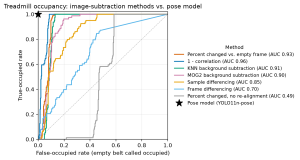
Classical image-subtraction methods vs. the pose model on our treadmill clips. The pose model (star) gets every check right; the classical methods trade missed people for false alarms.

I also double-checked our treadmill labels against the video.

Schedule status

The treadmill software is still ahead of schedule as a laptop prototype. However, since the design report took priority, I didn’t get to last week’s hardware tasks: the Jetson board check, the live camera-to-tablet test, recording new clips, and the recording permission. These are now my main risk. Our schedule has the first Jetson tests in the week of October 19, after fall break, so I’ll start with the board check since everything else depends on it.

Deliverables for next week

– Run the treadmill board check on the Jetson by October 21 (timing, memory, temperature), and compare it with my laptop results.
– Try a TensorRT export of the pose model, and keep it only if its results match.
– Run a live test from the C922 camera to the tablet, timing how long each change takes to appear.
– Submit the UC gym recording permission request, and confirm our backup gym.
– Record more treadmill clips with teammates, saving some for final testing only.

Alan Wang’s Status Report for 9/26

Accomplishments this week
This week, I prepared the design-review presentation and its supporting material. The package includes ten slides, architecture diagrams, design alternatives, a testing plan, a schedule, speaker notes, and scripts for generating the figures and slides. I also documented our decisions, preliminary evidence, and remaining questions so that this work can support the design report.
I included preliminary experiments investigating the vision approach. The detector check confirms that YOLO11n recognizes people and some common belongings, but its pretrained classes do not include weight plates. On generated gym stand-in images, some plates were assigned an unrelated class. This means the bench check needs its own validation and potentially training; a confident detection does not establish that the object is a weight plate.

Schedule status and corrective actions
The design-presentation work is in place, while camera-placement validation and real-footage testing remain open dependencies. These tasks need attention so that the design report can include evidence from representative scenes rather than only preliminary examples and simulations.
I will resolve the recording location and permission status with the team. If gym access is unavailable, we will use an appropriately authorized controlled setup with consenting participants. I will also help revise the presentation so that estimates, simulations, and measured results are clearly distinguished.

Deliverables for next week
•    Finalize the vision-related claims and figures for the design presentation due September 27.
•    Prepare a scene checklist covering occupied and empty treadmills, belongings left at a rack, an empty bar, plates on a bar, and plates correctly stored nearby.
•    Collect an initial approved set of staged examples and document the camera angle and lighting. If approval remains pending, finish the test protocol without recording unapproved gym footage.
•    Compare simple image processing with a detector-based approach and document failure cases.
•    Determine what additional labeled plate data is necessary before beginning a larger training effort.

Alan’s Status Report 9/19

Accomplished

This week I looked at how much of our detection we get for free from a pretrained model. I went through the classes it covers and wrote a short script to run it over gym images and count what it finds. People, backpacks, handbags, and bottles are all classes it already knows, which covers most of what gets left at a rack. Weight plates are not, and neither are towels, so the bench check will need training on our own labeled images rather than working out of the box. That is what we expected, but it is good to have it confirmed early. I also started looking into whether any public datasets include gym plates so we do not have to label everything from scratch.
I started on camera placement as well. The main issue is that people and equipment block the view, so I have been working through mounting height and angle for each check and what each camera has to be able to see. The bench camera is the tricky one, since it needs both the bar and the plate storage area in frame so we can tell plates that were put away from plates left on the bar.

Progress

Mostly on schedule. The detector work is done and the plate result was not a surprise, since time to collect and label images is already in our schedule. The camera placement plan is started but not finished, and I will finish it Sunday.

Deliverables

Finish the camera placement plan and take photos of the candidate positions. Record a first round of footage, at the gym if permission comes through and at a mock setup otherwise, and start labeling plate images. Help with the design presentation slides.