Team Status Report for 11/08/2025

Accomplishments

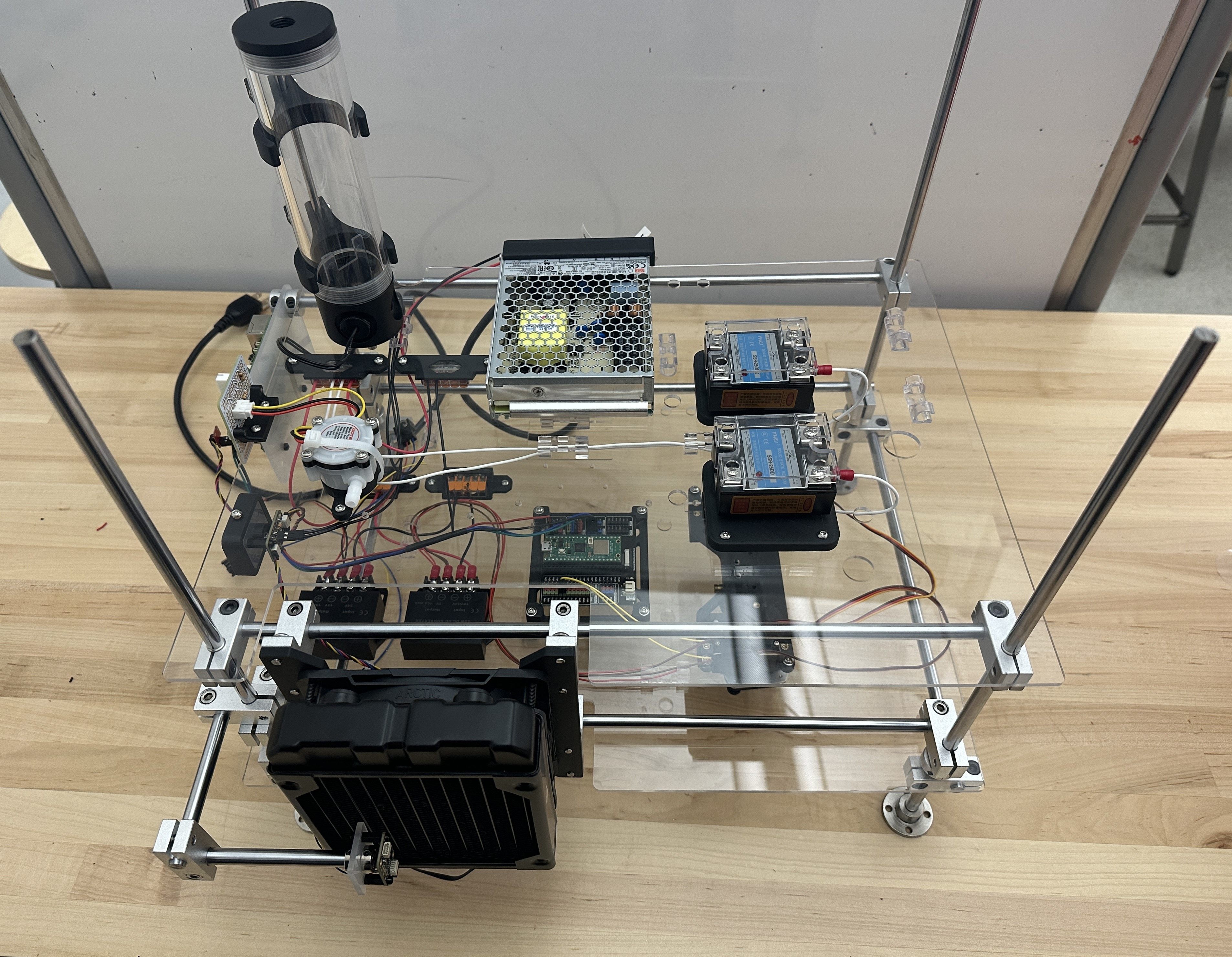
  • System Integration: Completed integration of all major components, including pump, heaters, fan, sensors, and servos
    • Verified basic operation of each subsystem
    • Integrated Pi 5 and Pico code for synchronized control commands for SSR, fan, and pump through UART
  • SSR Calibration: Used oscilloscope testing to characterize relationship between PWM duty cycle and power output
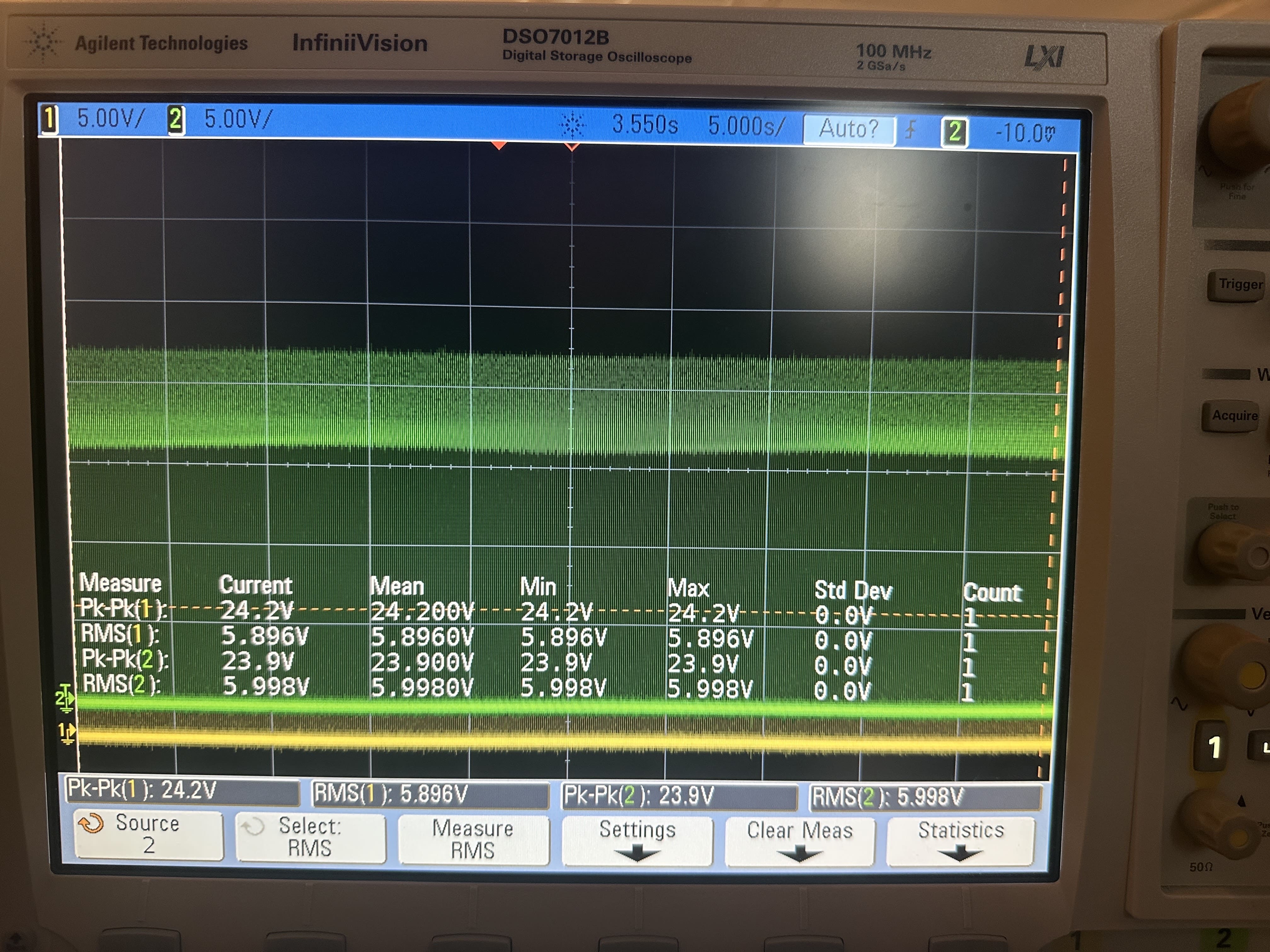
    Using Oscilloscope to Measure Vrms of SSR Output to Resistors
  • Data Collection Pipeline: Completed logging of temperature, RPM, and power data from sensors and Pi 5 commands into InfluxDB

    Grafana Dashboard of Temperature Readings
  • Started preliminary data collection using constant power hold tests (20-40W)
  • Flow Calibration: Mapped duty cycle values to flow reduction rate %
    • Used oscilloscope to debug flowmeter reading problems

      Using Oscilloscope to Measure Flowmeter Output to RPi5 Input GPIO Signal

Significant Risks

  • Limited Data Collection Time: With only a few weeks left in the semester, there is limited time to gather a large enough dataset for ML model training
    • Risk mitigation: Run automated, continuous overnight tests and streamline test sequencing to maximize data volume
  • Power Supply Limitations: Current power supply does not provide enough wattage for full-load operation
    • Risk mitigation: Acquiring a second power supply with higher capacity to support higher power testing

Design Changes

  • No major design changes this week

Schedule Changes

  • Schedule adjusted to allow additional time for data collection
  • Project remains on track, with initial data collection underway

Kristina’s Status Report for 11/08/2025

Hardware Integration & Testing

  • Finished full testbed assembly
  • Started testing on actual hardware setup (pump, fan, heaters, sensors all active)
  • Verified operation of all components under load

SSR Calibration

  • Conducted oscilloscope testing to measure duty cycle vs. output power
  • Derived a linear equation relation PWM duty value to wattage output
  • Updated control code to use calculated duty values

Integration

  • Finished integrating UART communication between Raspberry Pi 5 and Pico
  • Verified that heartbeat and command messages correctly sent and received

Schedule & Progress

  • On schedule
    • Debugging hardware issues and calibration tasks from last week have been resolved
  • System now ready for automated data collection testing

Next Steps

  • Write and test automated data collection routines on the Pi 5
  • Begin extended test runs to log data continuously
  • Start ML code development

Aidan’s Status Report for 11/08/2025

This week, I worked on finishing up the tests for the Pico to SSR, Servo, Pump, and Fan. This resulted in successful connections to all the components through the Pico code. Then, I finished the main loop run script to ensure it would integrate with the Pi. This resulted in a successful integration, so the Pi can control the Pico through commands in a fail-safe manor. I also troubleshooted and debugged some issues with the SSR and Flowmeter successfully. Lastly, I met with my group to prepare for the Demo.

Next week, we plan to continue fine tuning data collection and working with the full pipeline to ensure all bugs are addressed.

The current schedule is on track and will allow for successful data collection given the current status of integration.

Jacob’s Status Report for 11/08/2025

This week, I set up InfluxDB, our database, locally on the Raspberry Pi 5. I developed code to read the temperature (°C) before and after the radiator, as well as the temperature (°C) in the coolant reservoir from the thermistor. I also wrote code to capture the tachometer readings (RPM) for the radiator fan and coolant pump. Lastly,  a data collection method was implemented to store the readings into the database, and a Grafana dashboard was built, allowing us to visualize and monitor the data.

Next week, I plan to research power usage outputs related to CPU overheating, run the testbed to collect data to train our Machine Learning Model, and start developing our Machine Learning Algorithm.

We are back on track with the schedule and should continue to meet our target deadlines.

Aidan’s Status Report for 11/01/2025

This week, I assisted with the testbed assembly by threading the holes required to mount the resistors to the aluminum mounting board. I also ensured the resistors would make sufficient contact by sanding the part and utilizing a countersink to get rid of excess metal post threading. Additionally, I assisted with pwm testing to ensure the fan and motors had control through the pico.

The schedule is currently on track and should allow us to move forward with further integration next week.

Next week, I plan to assist with various integration needs and ensure the testbed is fully constructed and the control loop is completly finalized.

Jacob’s Status Report for 11/01/2025

This week, I contributed to building and assembling the testbed by drilling holes in the metal plate to mount the power resistors. I also worked on the other temperature sensor code. We also had a guest speaker this week, and I reflected on the ethical aspects of our project while completing the ethics assignment, in particular considering our stakeholders and the three readings we discussed.

This week’s progress was steady. My main plan for the coming week remains largely unchanged. My next steps are to refine the sensor code, develop the alert system, and establish the database framework to store sensor inputs. After connecting all of these together, I will test basic data flow from the Pi to the dashboard.

Team Status Report for 11/01/2025

Accomplishments

  • Testbed Assembly: Completed assembly of the basic testbed
  • Pump Mounting: Began mounting the pump but encountered alignment issues
    • Explored alternative mounting solutions to secure it properly
  • Aluminum Board Fabrication: Threaded and sanded the aluminum mounting board for the resistors to prepare for assembly
  • PWM Testing: Performed initial PWM testing on the fan
    • Confirmed PWM control
    • Plan to start pump PWM testing once full water loop is assembled
  • Sensor Integration: Completed sensor wiring and testing
    • Successfully read data from the TMP117 temperature sensors and the ADS1115 ADC used for coolant temperature sensor through the RPi5

Significant Risks

  • Pump Mounting Delay: Assembly progress was slowed by misalignment in the pump mount
  • Risk mitigation: Plan to either zip tie pump to acrylic board or use thread reducer to fix alignment issues

Design Changes

  • No major design changes this week

Schedule Changes

  • Schedule remains the same
  • Project remains on track to begin integration next week

Kristina’s Status Report for 11/01/2025

Testbed Assembly

  • Assembled the basic testbed and power routing
  • Brainstormed alternative ways to mount pump
Partial Assembly

Schedule & Progress

  • Slightly behind schedule due to fit issues with the pump mount
    • Mounting holes did not align
  • Exploring alternative mounting solutions to get back on schedule

Next Steps

  • Complete water loop assembly with tubing
  • Begin SSR PWM control testing with Pico once loop is complete
  • Add resistor and water block assembly for load simulation

Jacob’s Status Report for 10/25/2025

This week, I finally got my computer connected to the Pi5 after adjusting my personal computer settings and adjusting my SSH configuration settings. From there, we set up the temperature sensor on the Pi5, and I wrote some code to test its basic functionality. This worked, allowing us to expand to multiple sensors.

I am still slightly behind schedule. I need to start making the live database and the alert system. But within the following weeks, I’m confident that I can keep making progress and a good pace and catch up.

Next week, I intend to configure each individual temperature sensor rather than only have the default sensor read. I’ll set up the alert system so that, given some input (an arbitrary one for now since we don’t have our algorithm running yet), the Pi5 sends a formalized alert to the user. I also plan on developing the framework for the database so that we can collect some inputs.

Aidan’s Status Report for 10/25/2025

This week, I worked with the team to integrate the new Pi Pico workflow with the existing UART setup. This provided clarity for the Pico design and allowed me to move forward with further implementations in the control loop. I also assisted the team in inquiring about pricing for acrylic to aid in production of the testbench construction. This resulted in ordering precut parts for the testbench.

The schedule is currently on track and should allow us to move forward with further testbed construction next week after the precut acrylic is received.

Next week, I plan to continue integrating the Pico with higher voltage servos as we construct our test bed with external power supply. I also plan to finish fleshing out the design that communicates with the heaters, ensuring safe operation and fail-safe control loop functionality, while assisting further with testbed construction and misc integration.