Aidan’s Status Report for 11/22/2025

This week, I was unable to attend 18500 because I was very sick all week with the flu. I made sure to stay in contact with my team while under these unfortunate circumstances. I communicated regarding post-demo and updates to our model training/progress. This allowed me to stay on track for next week after recovering from my illness to assist with all items leading up to the final demo and presentation.

Our schedule is currently on track and we plan to focus on the final presentation and ensuring our model training stays on track for final demos.

For my portion of AnomAIy, I was responsible for learning various new platforms to develop, debug, and integrate all items regarding the Raspberry Pi Pico. This involved learning how to use the Pico, MicroPython, and the Raspberry Pi for Pico to Pi communication. These platforms were all completely new to me and required me to utilize my prior experience with microcontrollers to learn and develop on new platforms. Some learning strategies used to acquire this new knowlege included watching youtube videos detailing Pico setup, reading articles written for MicroPython newbies, and researching forums that detailed debugging strategies when unusal errors occured with integration.
Team Status Report for 11/22/2025

Accomplishments

  • Data Collection: Completed power-fault data collection
    • Started reduced flow data collection loop
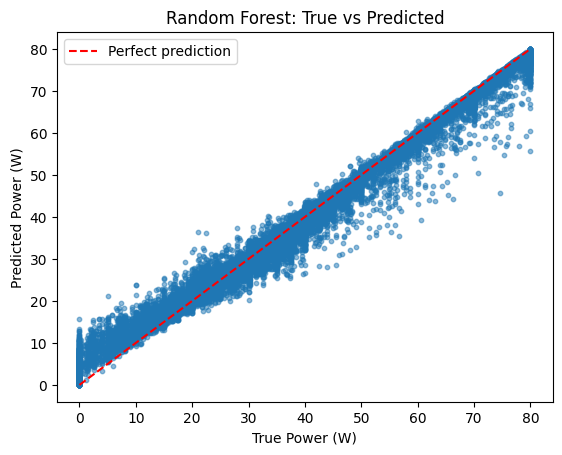
  • Regression model: Finalized and validated model for predicting CPU power

  • Autoencoder anomaly detection model: Implemented AE using RF residuals
    • Completed initial tuning: window size, latent dimension, dropout, batch size
    • Implementing event based fault detection instead of window based to fix poor separation between normal vs. fault cases 
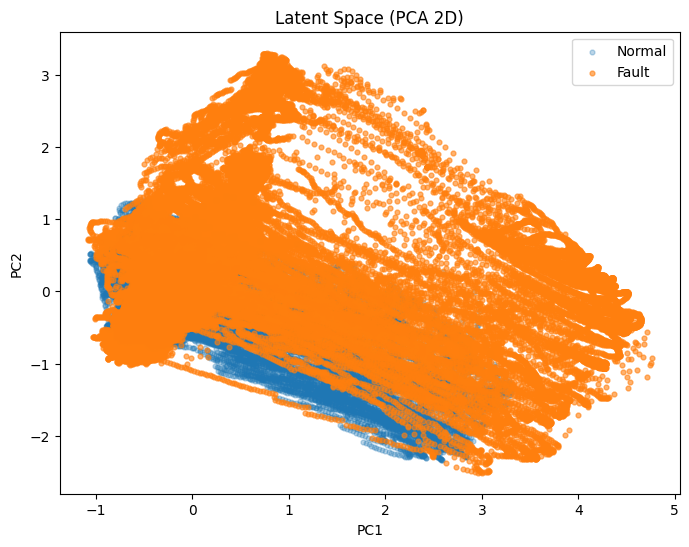
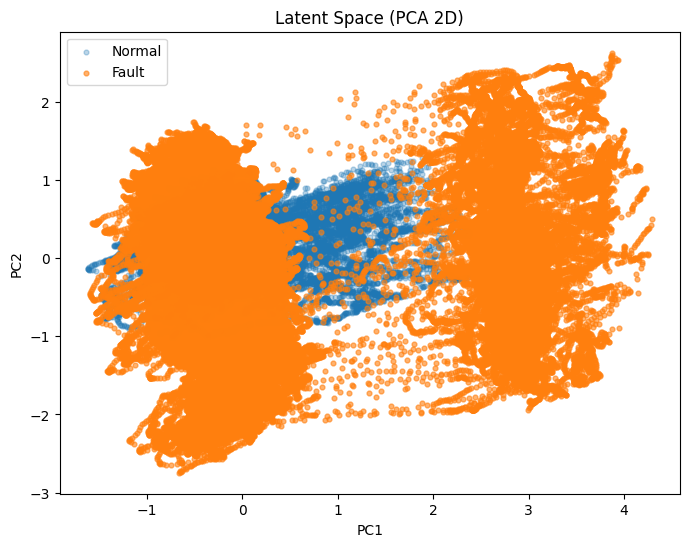
      PCA After Tuning

      PCA Before Tuning

Significant Risks

  • Normal fault overlap in AE latent space: PCA shows fault and normal windows are not cleanly separable even after tuning
    • Window level anomaly detection may be unreliable due to overlap
    • Risk mitigation: Switching to event-based detection, which only requires detecting a fault at least once per event

Design Changes

  • No major design changes this week

Schedule Changes

  • Project remains on track
    • ML model tuning in progress

Kristina’s Status Report for 11/22/2025

Data Collection for Fault Cases

  • Completed power fault synthetic test patterns
  • Started reduced flow synthetic test patterns data collection loop

Regression Model for CPU Power Prediction

  • Finalized feature set and preprocessing for regression model
  • Validated regression model performance on synthetic traces and exported model for use in autoencoder

Autoencoder Anomaly Detection Model

  • Implemented sliding window AE on RF output
  • Tuned initial architecture (window size, latent dimension, dropout, batch size)
  • Ran verification sweep on fault windows
  • Found strong overlap between normal and fault windows causing inconsistent fault detection
  • Developing event based detection: detect at least once per fault event rather than per-window

Final Presentation

  • Started drafting final presentation slides

Schedule & Progress

  • On schedule: working on tuning ML model

Next Steps

  • AE tuning + final presentation slides

Learning Strategies

  • ML autoencoder: Learned to build autoencoder for anomaly detection
    • Used Medium blogs, GitHub examples, and other people’s AE projects to understand typical structures and tuning strategies
    • Referenced scikit-learn documentation and online tutorials for scaling, windowing, PCA plotting, and general debugging
    • Already had background from ML classes but needed to apply to actual sensor data
  • Testbed Assembly: Had previous experience with similar setup with Raspberry Pi 5 and sensors so integrating was familiar
    • Had to learn how to run long data collection loops
    • Communicate between Pi and Pico over UART
    • Learn to flash code and debug UART on Pico with online tutorials and datasheets
  • Practical Skills:
    • Crimping connectors and assembling hardware setup
    • Used YouTube videos, forums, and online guides
  • Overall, most new knowledge came from informal learning
    • Videos, online blog posts, GitHub repositories, datasheets, and example projects

Jacob’s Status Report for 11/22/2025

This week, I was mainly focused on continuing data collection. Some time was also spent helping Kristina refine and adjust the regression algorithm as needed. Overall, everything remains on track as we progress toward the project’s completion.

Next week, we plan to wrap up the remaining tasks and prepare what we’ll present for our final demo.

Jacob’s Status Report for 11/15/2025

This week didn’t bring many changes to our project. Our first demo presentations went well, and we started collecting data for the database. We ran sweeps on our variables, including different levels of flow restriction and simulated VRM power output, to observe how our testbed reacts and cools down. We based these changes of flow restriction and VRM power output on previous research. The values are then being stored to build a large dataset, which will be used to train and test our machine learning algorithms.

The project is still on track. Next week, we intend to implement the alert system and begin developing the regression and autoencoder models for anomaly detection.

Aidan’s Status Report for 11/15/2025

This week, I supported the team through Interim demos by ensuring the functionality of the Pico as the cooling loop begins data-collection and complete operation. After demos, I assisted with finalizing test patterns for intial data collection to ensure our testbed models realistic workloads. Additionally, I developed fault-condition test cases to run on the testbed after initial data collection to ensure our dataset is thorough enough to provide anomaly detection that aligns with our technical requirements. The schedule is currently on track, and next week, we plan to continue data collection and fault simulation to build out our regression model for power prediction.

Team Status Report for 11/15/2025

Accomplishments

  • Hardware Upgrades: Replaced previous PSU with higher-wattage power supply for full-load heater testing

    300W PSU on Testbed
  • Testing & Data Collection: Began running automated test patterns including ramp up, ramp down, spike, and multi-level hold profiles
    • Completed synthetic data collection patterns covering full power range (20-80W)
  • CPU Power Trace: Collected power trace from a laptop using HWiNFO to generate realistic workload profile for testbed
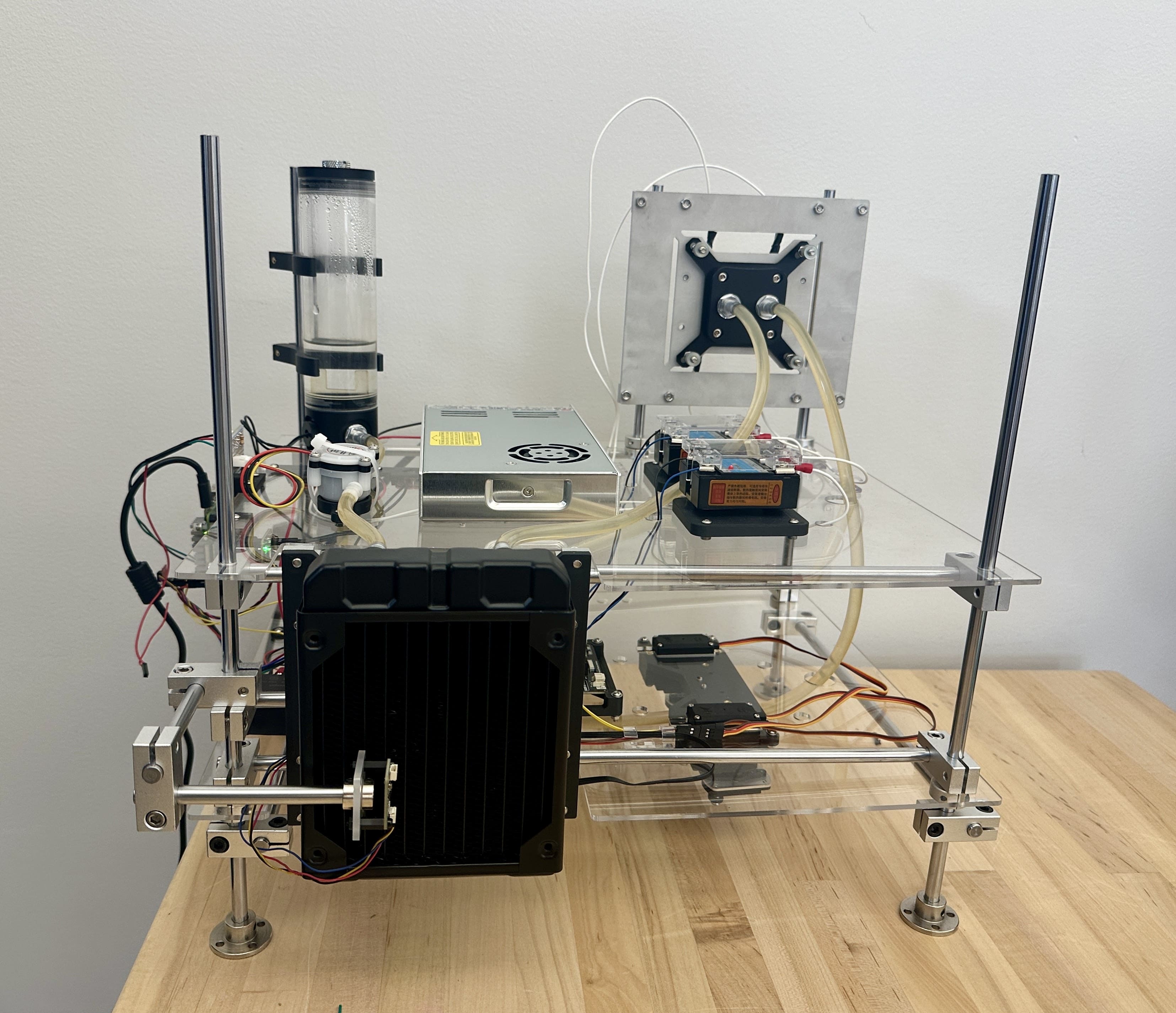
Updated Testbed Assembly

Significant Risks

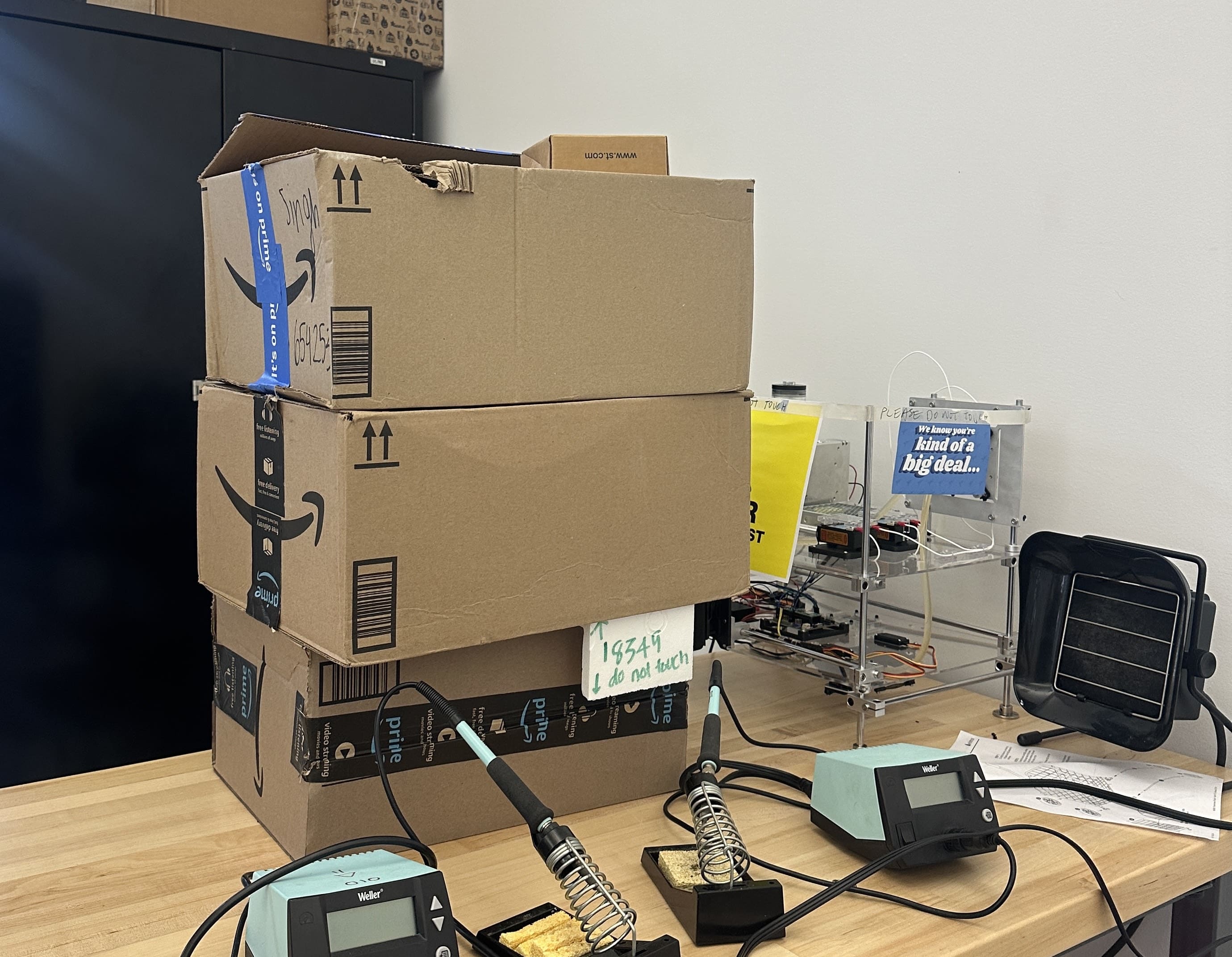
  • Interference from Other Classes: Embedded systems class is storing large boxes directly in front of testbed’s intake fan area
    • Obstructions may alter airflow, reduce heat dissipation, and affect temperature sensor readings
    • Risk mitigation: Hope that embedded will move boxes soon
Amazon Boxes Blocking Testbed Fan

Design Changes

  • No major design changes this week

Schedule Changes

  • Project remains on track
    • Synthetic data collection now complete for normal operation
    • Running real traces

Kristina’s Status Report for 11/15/2025

Hardware Updates & Repairs 

  • Replaced previous PSU with a higher-wattage supply to start full-load heater tests
  • Fixed issue where screw heads completely de-threaded
    • Used pliers to remove and mount new PSU
  • Verified stable operation of power output with new PSU

Data Collection & Testing

  • Began running automated synthetic test patterns, including:
    • Ramp up and ramp down CPU power profiles
    • Step spikes
    • Holds
  • Debugged issue where tests suddenly stopped mid-run
  • Finished a complete sweep of synthetic data collection
  • Collected real CPU power traces using HWiNFO on my laptop to simulate realistic user workloads
    • Imported traces into power traces and successfully began running them on testbed

Schedule & Progress

  • On schedule

Next Steps

  • Begin processing data
  • Start building regression model to predict power output
  • Start fault-condition runs to collect fault data for anomaly detection

Team Status Report for 11/08/2025

Accomplishments

  • System Integration: Completed integration of all major components, including pump, heaters, fan, sensors, and servos
    • Verified basic operation of each subsystem
    • Integrated Pi 5 and Pico code for synchronized control commands for SSR, fan, and pump through UART
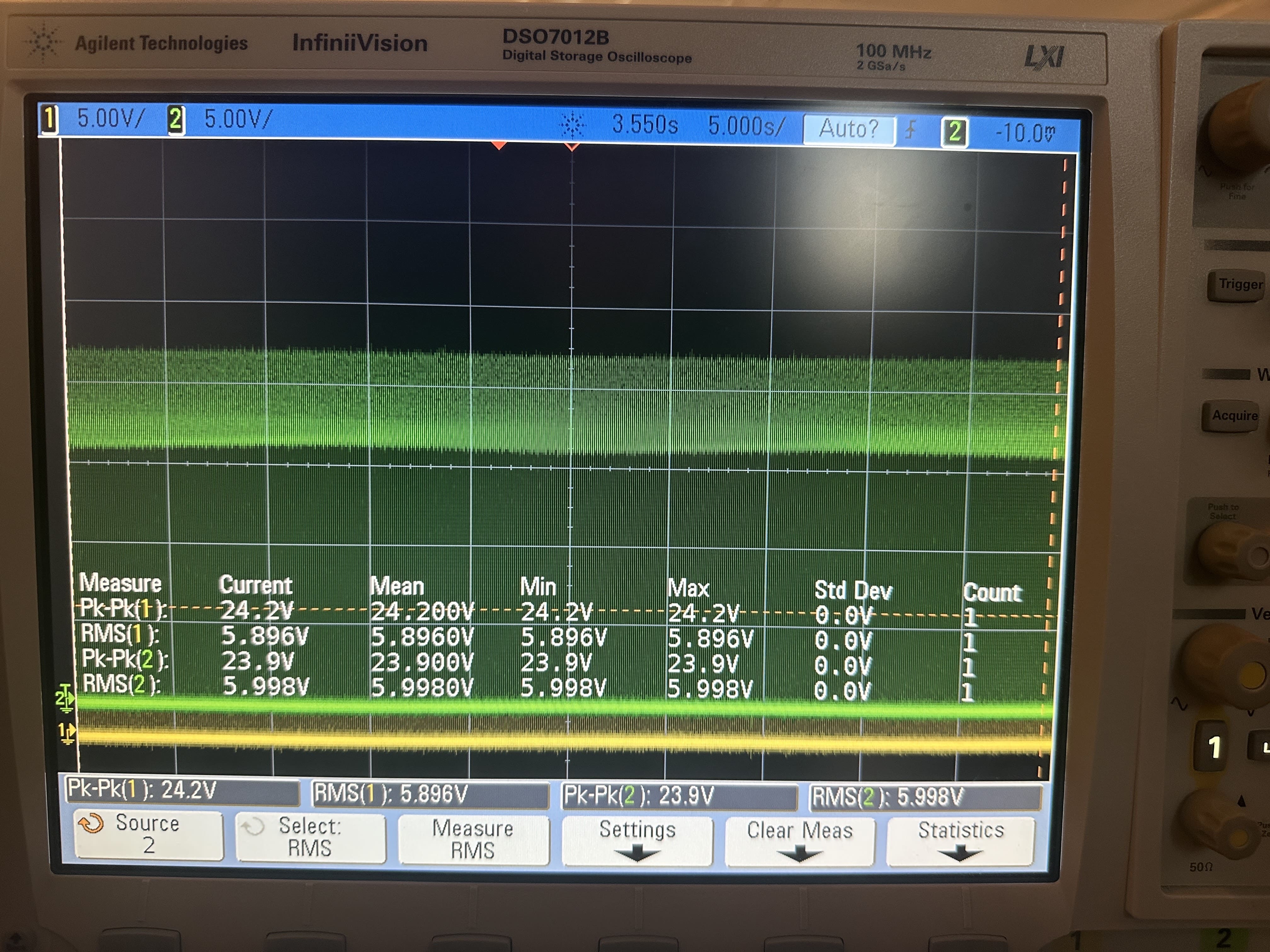
  • SSR Calibration: Used oscilloscope testing to characterize relationship between PWM duty cycle and power output

    Using Oscilloscope to Measure Vrms of SSR Output to Resistors
  • Data Collection Pipeline: Completed logging of temperature, RPM, and power data from sensors and Pi 5 commands into InfluxDB

    Grafana Dashboard of Temperature Readings
  • Started preliminary data collection using constant power hold tests (20-40W)
  • Flow Calibration: Mapped duty cycle values to flow reduction rate %
    • Used oscilloscope to debug flowmeter reading problems

      Using Oscilloscope to Measure Flowmeter Output to RPi5 Input GPIO Signal

Significant Risks

  • Limited Data Collection Time: With only a few weeks left in the semester, there is limited time to gather a large enough dataset for ML model training
    • Risk mitigation: Run automated, continuous overnight tests and streamline test sequencing to maximize data volume
  • Power Supply Limitations: Current power supply does not provide enough wattage for full-load operation
    • Risk mitigation: Acquiring a second power supply with higher capacity to support higher power testing

Design Changes

  • No major design changes this week

Schedule Changes

  • Schedule adjusted to allow additional time for data collection
  • Project remains on track, with initial data collection underway

Kristina’s Status Report for 11/08/2025

Hardware Integration & Testing

  • Finished full testbed assembly
  • Started testing on actual hardware setup (pump, fan, heaters, sensors all active)
  • Verified operation of all components under load

SSR Calibration

  • Conducted oscilloscope testing to measure duty cycle vs. output power
  • Derived a linear equation relation PWM duty value to wattage output
  • Updated control code to use calculated duty values

Integration

  • Finished integrating UART communication between Raspberry Pi 5 and Pico
  • Verified that heartbeat and command messages correctly sent and received

Schedule & Progress

  • On schedule
    • Debugging hardware issues and calibration tasks from last week have been resolved
  • System now ready for automated data collection testing

Next Steps

  • Write and test automated data collection routines on the Pi 5
  • Begin extended test runs to log data continuously
  • Start ML code development