Team Status Report for 10/4

Working through calculations and details of design report.

Additional circuitry and component selection for interface PCB, finalizing LED driver PCB with supporting simulations.

Collecting parts to order, specifically those needed to verify firmware and conduct preliminary tests that don’t require the custom PCBs.

Sid’s Status Report for 9/27

This week, I worked on generating peripheral clock configurations and verified that the MCU we chose would work with all of the peripherals we needed. I also determined how to set up the GPDMA peripheral to properly route data. In addition, I worked on the design presentation and made some block diagrams for our HW/SW architecture.

I am on schedule for now, I need to get DMA and UDP code done over the next week and make sure it is compiling, so that is my main goal.


Team Status Report for 9/27

Selected specific STM32 chip (STM32H563RI) and configured peripherals.

Selected clock modulation IC that works with EPC660 and EPC21603 (single ended + LVDS differential, respectively).

PCBs of MCU+interface and control board schematics underway, along with verifying design through simulations.

Design presentation preparations and communication of necessary requirements across modules and firmware.

No pushbacks in schedule nor changes in design.


Part A(Sid):

The Illuminator can be beneficial for many aspects of public safety and welfare. Underwater robots are required in many critical applications such as water tower maintenance and underwater shipwreck recovery operations. By increasing the resolution, cost-effectiveness, and field of view of these robots using a visible light ToF camera, loss of life can be prevented by increasing the effectiveness of recovery operations. In addition, water towers can suffer from corrosion and leakage of poisonous materials. By accurately inspecting scale and buildup on the inside of water towers with robots, these dangerous growths can be identified earlier before they leach into supplies.

PartB(Claire): Not applicable. Our sensor system does not ignite social activities in any way as it does not have a human to human interaction in its design. It does not emphasize cultural awareness or political campaigns, and is not intended for any of those purposes.

PartC(Gleb): The main application of our underwater ToF camera is to provide volumetric vision capability to AUVs doing close-range manipulation. In general, AUVs are expensive, with prices in tens or hundreds of thousands dollars. Therefore our sub-$1000 sensor will constitute only a small fraction of the vehicle cost.

Currently, the only feasible alternative for close-range 3D vision underwater are stereo-cameras. A high-quality stereo-pair cost is typically $500 or more. For example, the cameras used for stereo-vision on TartanAUV’s Osprey submarine cost around $3500 each. Therefore, our system is very competitive in terms of cost. Additionally, a ToF sensor has certain advantages over stereo-pairs, which we discussed in our design proposal.

Gleb’s Status Report for 9/27/2025

  • Primarily busy with clock architecture + design presentation
    • We need to supply synchronized clocks to the EPC660 sensor IC and the LED driver. The clocks should be synchronized, with the sensor clock being double the frequency of the modulation clock. Furthermore, the phase delay should be adjustable to enable to allow us to run the sensor in the imaging mode, and to allow us to compensate signal propagation delay between boards.
    • I have explored different discrete clock generation solutions, while Sid has looked into clock generation on STM32 directly. For instance, I have looked into using an external PLL chip or a flipflop frequency divider. Additionally, I have explored adding a quadrature signal and using VGAs to enable the phase shifting.
    • Our final solution  is using Si5338 four-channel clock generation IC. It supports both single-ended and LVDS signalling, which is convenient for using it with EPC660 as well as the modulation driver. The frequency and phase delays will be configured from the MCU via I2C.
  • I have also imported LED and driver models into PSPICE.
  • I will be running simulations and designing the LED PCB next week.

Sid’s Status Report for 9/20/25

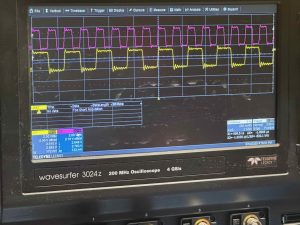
This week, we did our proposal presentations. I spent last weekend making a Gantt chart for our proposal and determining specific tasks for all of us. This week, I started autogenerating firmware using STM32CubeMX. We tested out the clock generation functionality with an oscilloscope with a Nucleo board. We were able to also verify that two clocks on two different GPIO pins were synchronized without phase delay.

Next week, I plan on starting the DCMI firmware and setting up the DMA pipeline from the peripheral to memory.

Claire’s Status Report for 9/20

09/20

Component, headers, and MCU selection complete after confirming compatibility on data sheets. Figured out powering board / supplies needed as well as voltage step-down circuitry. Notes below.

Digital

3.3V VDDIO for high speed IO pins like MODCLK

Lots of switching noise, supply wires and layers must be carefully designed and isolated in a separate supply island on the PCB

-> step down to 1.8V for VDD VDDPLL

Analog

+5V for internal analog circuits 

External Power Supply (for now)

+10V VDDPXH pixel field circuit

-10V VBS biasing pixel field

Progress is on schedule!

Next week: Layout PCB through Altium Designer

Gleb Ryabtsev’s Status Report for 9/20

  • Researched various high-power high-frequency LED driver configurations.
  • Settled on EPC21603, a 100MHz laser diode driver.
  • Prepared P-Spice models and environment but haven’t ran comprehensive simulations yet.
  • My progress is on track. We are planning to spend the next week running the P-Spice simulation and doing some more testing on an STM32 breakout board. Once those steps are complete, we can proceed with designing the PCBs.

Team Status Report for 9/20

  • Our project relies heavily on custom high-speed mixed-signal PCB design. Issues with the PCB performance can jeopardize the success of our project. We are taking steps to de-risk:
    • We are running P-Spice simulations of the analog circuitry to verify the high-frequency behavior (at steady state).
    • We are doing test on an STM32 F7 eval board to make sure that we can generate synchronized modulation clocks for the LED and the sensor chip. See the picture below.
  • We haven’t changed the system design, but we have worked out the specifics of the LED modulator circuit.
  • No schedule updates.