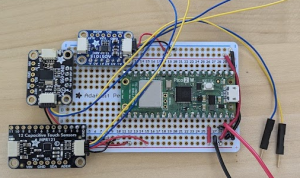
The two remaining tasks before demo are wireless integration and to record more trials so the accuracy improves from 92% to 95%. Kat has been focusing on wrapping up the wireless integration since the demo, but we know the glove functions well with the cable connection. It’s possible the wireless implementation will add latency to the data classification, but the delay would be minimal due to the small amount of data we’re sending. More data collection will only improve the model, so there are few risks with continuing.
Software unit testing: Tested the UI/UX with mock results for the entire character set and added buttons (shuffle set, reset, show signs) to improve the user experience.
Hardware unit testing (Teadora): confirmed connectivity/voltage from flex sensors into ADS with a multimeter. Confirmed I2C connectivity (with Kat) by receiving data on the console through cabled connection. Tested multiple conductive pad placements and attachment methods, and confirmed functionality using the suggested libraries for the breakout board and “touched” function.
Overall system test: Tested the full pipeline by collecting data from the pico when the frontend sends a request, sending the data to the model for evaluation, and posting the model’s evaluation to the frontend. We are finding that the accuracy drops significantly when testing the entire system which is what we are currently working to improve.