
Ishaan Verma’s Status Report for 10/10/2026

Work Completed this Week:
This week, I focused primarily on RF bring up and RESQUBE + rover design updates. In particular, for the RSSI localization implementation it was reached that the usage of a patch antenna is too directional in its emissions pattern to adequately support our implementation. As such, an alternative rod antenna was chosen with a similar price figure and reasonable attenuation. The implementation for the RSSI in minimally implemented for the RESQUBEs, but full integration will be completed later in the month. In addition, to make up for the attenuation that is lost in this switch, a back up was prepared for testing in the form of an external bidirectional RF Power Amplifier module, which can be easily slotted in if the need for it arises. For the RESQUBE and rover CAD, 3D printable files have both been made, with the RESQUBE having alternative versions for supporting different antenna and power amplifier configurations.
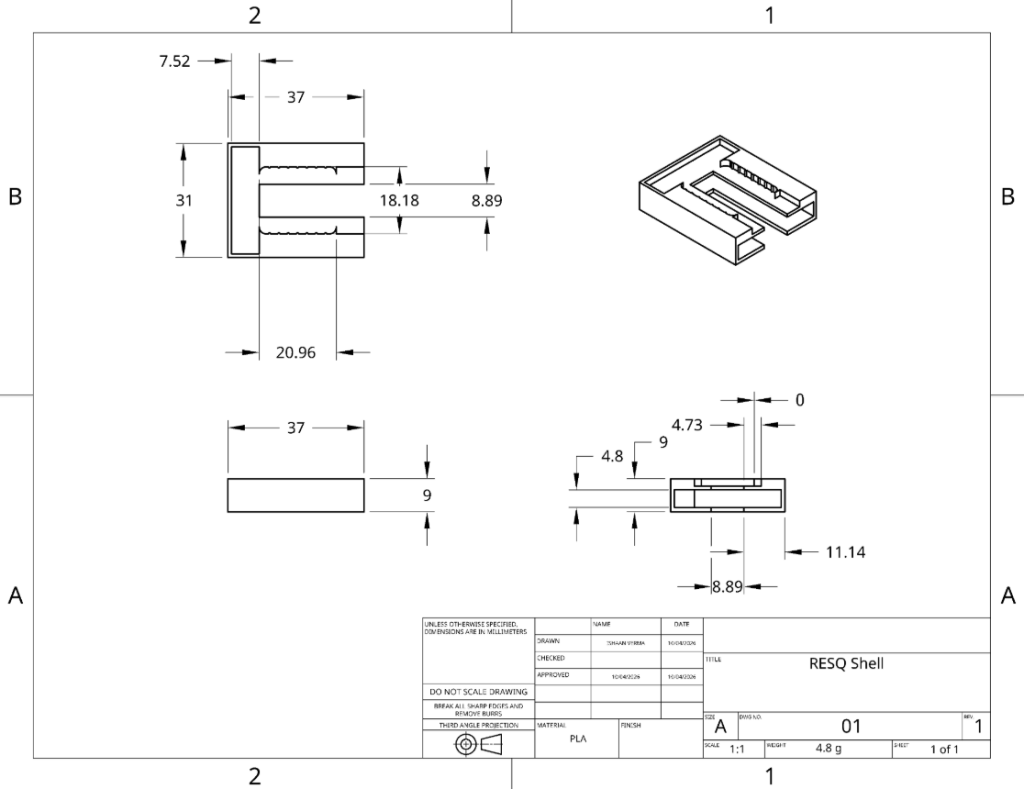
Minimal RESQUBE CAD for patch antenna configuration

Schedule Status:
I am on track with the schedule, and project to primarily be focusing on odometry and benchmarking.

Deliverables for next week:
The odometry implementation for the RESQ rover and benchmarking / validation of the RSSI implementation.
Ishaan’s Status Report for 10/03/2026

This week I focused on the development of the RESQ rover and RESQubes. My primary focus was on CAD for RESQube structure, RSSI and RF feasibility studies, component selection, and compatibility testing for the RESQ rover.

For the RESQube construction, I began working on a CAD of the external housing with respect to the dimensions of the RESQube’s components and I conducted some test prints using TPU and PLA to tune the settings of one of the 3D printers we are using and that I own.

For RSSI and RF feasibility studies, I assisted Raghav in his analysis of the mesh network’s feasibility for Thread, ESP-Mesh-Lite, and BLE. From the results he found, I determined along with Raghav and Mehaan that we would require a separate patch or rod antenna for each RESQube and to utilize ESP-Mesh-Lite. This was because the attenuation on the on board antennas was far too weak for our use cases, meaning both the RSSI and node-node mesh would be deficient for our purposes. As such, I conducted a trade study between two patch antenna and one rod antenna compatible with the ESP32-C6 and found a suitable patch antenna that satisfied our SWaP-C needs. Lastly, I worked on compatibility testing between the  Jetson Orin Nano, eYs 3D camera, and Intel RealSense LiDAR camera L515. This preliminary testing showed good compatibility between all 3 and showed that our high level system architecture is feasible.

For the weekly meeting, we covered the feasibility study and ordered new antennas, the rover chassis, and discussed our design report. For the design report we are transferring our work and testing results into it to help build the structure better.

For the week ahead we are aiming to finish the system implementation of the RESQubes and testing, which seems feasible with the antennas we ordered coming on Monday. In addition, I hope to finish my parts of the design report that were divided up to me and get a head start on more of the rover’s system architecture, specifically on victim localization using the three prototype RESQubes we will have.

Team Status Report for 10/03/2026

Design Change and Schedule: For design changes, our team tested out some of the options for mesh, namely Thread, BLE, and ESP-Mesh-Lite. In our study, we saw a lot more success in the implementation of ESP-Mesh-Lite.This was primarily because the system itself showed better promise for our use case over Thread and BLE alone. We also opted for a discrete additional antenna for our RESQubes since the onboard antenna showed disappointing results in range and stability. The new antenna is a low cost patch antenna with an approximate maximum 5dBi attenuation. In addition to this we progressed on track with our schedule, continuing testing for the RESQubes, working on the SLAM algorithm, creating prototype RESQube shells from PLA and TPU, working on the RSSI, and conducting trade studies based on our testing results to update our model. Along with this we have done some preliminary testing on compatibility between the camera, LiDAR, and Jetson by testing if they can communicate and recognize each other.

Risks and contingency: The main concerns we see with our future implementations is the size and weight allocation of an additional antenna to each RESQube. We are planning for patch antennas currently and are in the process of testing them, however if these are insufficient in supplying our needs there is a possibility to include a omnidirectional rod antenna. In our design, however, we have ensured that this worst case scenario would still ensure we are achieving our MVP for the size and deployment of the RESQubes.

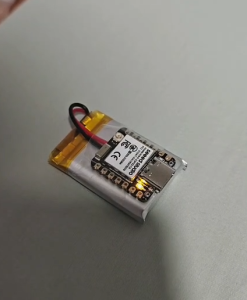
Below we have attached a picture of our testing platform for the RESQube we are currently using to test mesh capability and communication. The goal was to keep the system as simple as possible to test capabilities piecewise.

Ishaan’s Status Report 9/26/2026

This week focus was on figuring out specific metrics and testing scenarios for the rover and RESQUBES. This involved finalizing our BOM for the rover and then determining individual parts’ performance and validity for our system. In addition to this, I explored available software resources, particularly in SLAM, locomotion, and mesh networking, for the rover and nodes. With this our team was able to determine the requirements for integration and implementation of the software systems. The resources we found as a team have shown that the implementation of our system looks to be realistic in our timeframe without need for scaling back.
In addition to this, I put requests and orders for more hardware components we needed. Importantly I chose hardware such that it would be realistic to swap out in the rover without need for significant change in software and no change in scope. 

Part A: In considerations of public health, safety, and welfare, the most important aspect of our project is the victim and their safety. RESQ is intended to ensure the safety and well being of potential victims in a hazardous scenario while minimizing risks of rescue workers. The rover’s ability to map out rescue areas and identify hazards, listen to signals from victims’ phones, and relay information back to first responders all contribute to support survivors’ physical safety and well-being by helping teams identify where to focus their efforts.
The system must importantly avoid creating false confidence. Distortions in RF signals due to debris and unforeseen hazards could both compromise the information being given to first responders. Because of this, it is important to be transparent with the information being given to first responders and ensuring they have a full understanding of the information our rover provides. Importantly, we want to aid and support in rescue operations not fully replace their search methods and eliminate human oversight into rescue operations. 

Ishaan’s Status Report for 9/20/2026

This week I helped in making and preparing Raghav for the presentation on Monday and met with the team for our weekly meeting to discuss the plan forward.

For the weekly meeting, we touched on RESQube construction and part selection. I helped conduct a trade study for the microcontroller, battery, and epoxy being used for the RESQubes, selecting primarily for low-cost and small footprints. In addition, we discussed possible testing for the RESQubes to be done after construction and landed on testing propagation efficiency and power testing.

At the end of the meeting we had completed our BOM for the RESQubes, made a preliminary BOM for the RESQ rover, and put in orders for the construction of the first RESQube.

Future plans include receivin the parts, constructing the first RESQube, and testing the possible communication interfaces and bandwidths available for the mesh network and RSSI solution.