Team Status Report – 11/15

This week, we had our demo presentation. We think that our demo went pretty smoothly and the feedback we received was relatively positive. I think we need to work on getting the hardware components finished and printed so that we can connect all the pieces together to get a minimum viable product. Because I had to use the Intel NUC and not the Raspberry Pi that was given, I will need to move all the scripts and the files to the Raspberry Pi and make sure that it can communicate with the STM32 via UART. Crystal and Safiya need to continue working on the firmware and hardware components and finish cutting the dowels and complete the gantry system.

For validation, we need to do more user tests, specifically of the image that is outputted on the pin art board. We will do this by asking a bunch of people if they can see the image that is supposed to be outputted on the board. Additionally, we will do validation for the gantry system and the pin actuator system to ensure that they will push at a certain distance, given an angle. We will ensure that actuators are push pins to the intended heights 95% of the time. We will also make sure that the gantry will move down the belt consistently and with precision and accuracy.

———————————————————————————————–
For Verification of the mechanical subgroup, we will need testing of the gantry, the pin board, and the carriage. For the gantry we will we have the carriage travel up the gantry successfully 5 times, and be reset to its limit switches at the beginning and end. We will also make sure 10 times in a row the carriage travels to the correct row that is authorized by the code.

For the carriage specifically, we will test 3 different combinations of rack and pinion motions. The test will consist of full retraction of all actuators, full extension of all actuators, and actuators at different depths.

For the pin board, we will test that all pins are stable and able to be controlled by displaying 2-3 images of varying depths and checking through 1/3 of the pins to verify a sample set that the pins are working as they should and are stabilized.
———————————————————————————————–
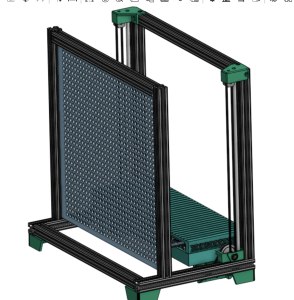
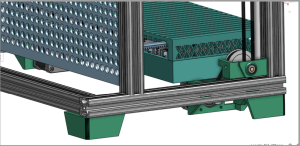
Frame Partially Built

Tedd’s Status Report – 11/15

This week, we partook in demos, which was split up between two main subsections. We had the software component, which showcased the depth camera and the python script that I wrote. We also had the firmware and hardware component, which tested the actuators pushing to max distance. Because our Raspberry Pi did not work before demos, I had to make use of my Intel NUC in order to get our script running and to be able to showcase the work on the software side.

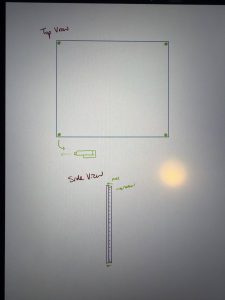
After demos, I was in charge of moving the script to the Raspberry Pi, just so that we won’t have to make use of the Intel NUC in the future. I am also in charge of the UART communication between the RPI and the STM32. Additionally, I am in charge of the reset mechanism, and I drew out plans to get the reset mechanism working. Here is my planned diagram:

As we move towards Thanksgiving break, we are hoping to be able to assemble most of the parts and have a fully working product in the next few weeks.

For the verification system for the software components, we need to make sure that the depth camera is properly calibrated and can display images clearly or at least get enough details to output on a pin board. We will do a bunch of user tests to verify that the image that is outputted is indeed visible. This will be done specifically by asking random people if they can see images are visible, given a diagram of pixels that are shaded in.

Safiya’s Status Report 11/8

Accomplished & Goals:

I will be breaking up the accomplishments and goals into three categories, carriage, frame/gantry, and pin board. As all three had progress in either CAD/Design, Fabrication, or Assembly.

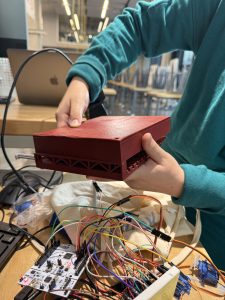
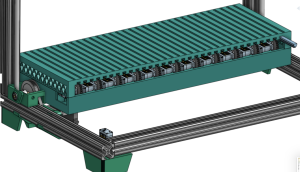
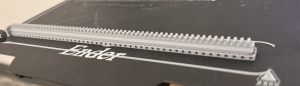
Carriage: I completed a “working” version of the carriage CAD, and began printing it. I split it into two for printing purposes as it was too big for my ender 3. The bottom print of the carriage took 17 hours, and the top took the same. It was crucial to have these done before last Friday as we prepped for demo. I updated the design of the racks to make them longer and the pinions to make them work with the 180 degrees servos instead of continuous ones. I printed 6/32 of the pinions and 4/32 racks.

Once everything was printed, then began the testing. I had to file the carriage down to make the racks slide smoothly, but once finished the racks moved really nicely. The pinions had problems mounting to the servos, so those had to be redesigned once more, and are currently printing.

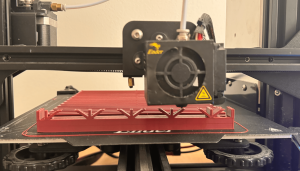
3D Printing bottom half of carriage
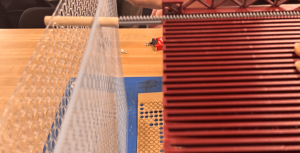
Carriage with rack pushing pin on pin board
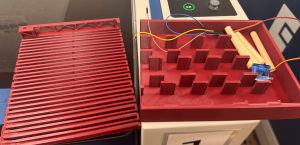
Carriage Assembly with pins and servo

The carriage works enough for demo, but needs some design changes and to be reprinted. I will be adding lightning holes for both weight, and room for the wires to pop out. I will also be increasing the size of the mounting holes. This redesign will take some time, and so I will allocate a good chunk of next week to it, in order to get it printed on time. I plan to get the design done this coming week and start printing again on Saturday. I also plan to print a majority of the rack and pinions throughout this week .

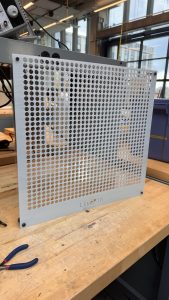
Pin Board: The Pin Board got two iterations this week. I finished the cad of the pin board on Sunday and laser cut it. The outer frame of the board wasn’t large enough to fit on the frame, and needed adjustment, another slight detail was the spacing on the holes, I ended up moving them closer together and fixing some geometry to make the carriage be able to reach all rows of the pin board. It now looks like this, with both boards assembled and spacers in between.

The dowels were calculated to need 5cm of offset, 1/8″*2 for the thickness of the pin board, 1″ for spacing in between boards, and 2 mm of clearance. A few were cut, and put on the board. Next week I hope to order all the dowels we need, and have them ready to cut for the week after.

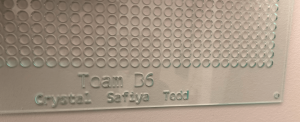
Newest Pin Board Print, with engraving
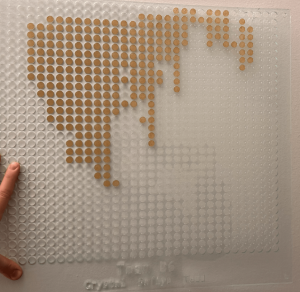
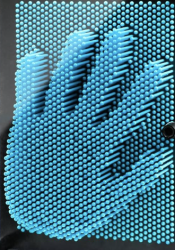
Leftover stickers display how an image can look on the pin board

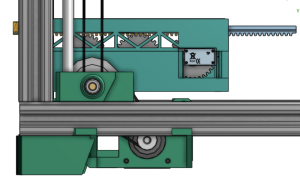
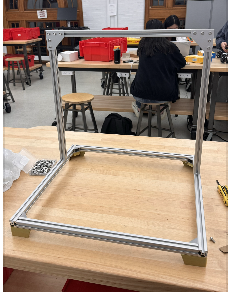
Frame/Gantry: We made some progress in getting pieces for the frame and gantry repurchased, and I believe we have everything except the heat inserts. I made some progress on the full assembly cad, but need to design the gearbox mounts, and the connections between the carriage and the frame. There is also a lot of assembly work to get done, I will hopefully assemble the frame next week and design the gearbox plate and the piece that connects the carriage with the frame.

CAD for Gearbox mount, not fully complete

Progress: On schedule, but a little tight on time for 3D printing and design.

Crystal’s Status Report – 11/8

This week I was able to somewhat concurrently run 4 servo motors and then sequentially run the stepper motor that powers the gantry. I am saying somewhat concurrently because timer 2 on the STM only has 3 usable channels. This leaves one of the servo motors running on a different timer, causing it to run out of sync with the other servos. I am investigating how to sync these two timers. While writing the stepper motor driver, I realized we never considered a stepper motor driver in our design. Given that our stepper motor will need to support the weight of the actuator carriage and 32 servo motors, I decided to purchase a heavy duty stepper motor driver. I also wrote a function that can convert the calculated depth to an angle the servo can rotate to. We also decided to use dowels as our pins. We tried hand sawing and using a miter saw to cut the dowels. The miter saw didn’t give a clean cut, so we will be hand-sawing for now. However we will try other saws.

I am on schedule. Hopefully, the pwm expanders will come in this week, so I can implement actuation with the pwm expanders.

Team Status Report – 11/8

This week, we met up multiple times as a team to talk about our progress and work together to get a minimum viable product done for the demo. Safiya worked on 3D printing all our parts and CADing our designs. Additionally, she worked on laser printing our LivePin board. Crystal is working on getting our servos working concurrently. Today we tested how well the servo works on the 3D printed board that Safiya worked on, and it was successful. Tedd finished the software pipeline, but needs to find a better hardware replacement for the Intel Realsense camera and needs a replacement for the Raspberry Pi.

Tomorrow, we will do a full run through of the demo that we are planning on showing. No changes were made to the existing design of the system. Right now, the most significant risks that could hurt this project is if we cannot get communication between the NUC and the STM32. Additionally, if we cannot get a good enough depth camera that could pick up small details, it could really jeopardize our project because our pins won’t be able to output a good enough image.

Here are a few pictures:

Tedd’s Status Report – 11/8

This week, I worked on getting the Raspberry Pi script done for the depth camera and the csv output. However, upon setting up the Raspberry Pi, I realized that it is actually faulty. As a result, we will be using my Intel NUC for the time being, just so that we have something to demo on for this week.

The script works well and prompts the depth camera when run, but I suspect that there is an issue with the camera because it is not able to pick up important facial features and details that other cameras should be able to pick up. We suspect that it may be a problem with the Intel Realsense camera and are hoping to find an alternative or purchase another one. It is important for us to be able to have a camera that can pick up small details because our picture will ultimately be downsampled, so if we are already at a disadvantage with our camera quality, we will be at a bigger disadvantage when it comes to our image output on the pin board.

Regardless, I am still able to run the script on the NUC, and it works well. All we need to get done is figure out a way to send the CSV file to the STM32 for further computation and ultimately allow us to push the pins out.

Safiya’s Status Report 11/1

Redesigned pinions to work for 180 degree servos, thus causing a redesing in the carriage. It got larger and all spaceing between servos were adjusted. I finished the CAD of the carriage.

I got my 3D printer working, made adjustments to the rack design, and got the first nice print of a rack. I am now starting to print the pinions, and then hopefully Sunday, the carriage.

I redid purchasing, as some of our Amazon purchases got lost due to the AWS crash event.

I am now designing the Z axis gantry system and gearbox, hopefully full CAD done by Monday.

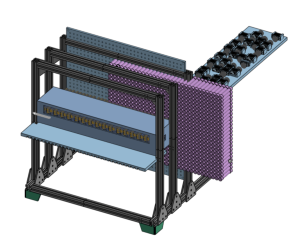
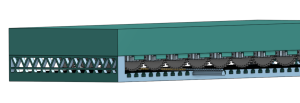
Here is the progress so far on the full assembly CAD, I included a before, so the progress can be shown, the first design (which is actually a second design) is all over the place and unfinished, more of a proof of concept, and the finalized design is the one that is more clean, with belt and stuff to proportion. It still has a couple more tweaks but will hopefully be done this Monday (11/3).

Pin Board is also a work in progress, especially designing its mounting system

A few design questions moving forward:
– Is one set of bars enough to support the carriage ?
– Is one pin board enough to support the pins?
– Where can reset mechanism go?
(after, V3)(before, V2)

Team Status Report – 11/1

Budget is still a big concern for the viability of this project. We currently cannot afford to buy dowels and 32 servo motors, so we are looking for other avenues to get free continuous servo motors. There has been a slight change to the design of the system, specifically the actuator subsystem. Though not specified in any documentation, we originally planned to use 180 servo motors. However, a rotation of 180 degrees is not sufficient enough to actuate the pins. Continuous rotation servos are more expensive, requiring us to spend $50, but I will see if I can hunt for some free ones.

Crystal’s Status Report – 11/1

This week I worked on the firmware of this project. I designed the architecture of the firmware by creating 4 schedulable tasks: the UART message, actuator movement, gantry movement, and reseting. I am on schedule. Next week I hope to be able to have the firmware working with at least 2 actuators, a gantry motor (since the other one didn’t come in), and actual UART messages with the actuator heights.

Tedd’s Status Report – 11/1

This week, I continued to work on getting the script that I created onto the Raspberry Pi that we acquired for our project. I outlined the steps we need to get this to work. First, I need to install all the required dependencies. Then, I would need to copy the script and data into the Raspberry Pi. Next, I would need to run the Raspberry Pi with a display, and then finally save the CSV so that it could be used for the drivers. This is a very simplified process of what I am currently working on.

The next steps after this to to work with Crystal and Safiya to start getting all the parts working together for our demo. In order to do this, I would need to coordinate with Crystal to make sure all the drivers are working properly, and Safiya to make sure that our design requirements are met and the system is built properly.