Team Status Report for 11/15

This week, our team spent most of our time preparing and doing the interim demos. We believe our biggest risk is still with our launch, as now we have to wait for our replacement motor board to arrive, but after our lower power tests this week we are more confident that it will launch our required distance of 20+ feet. This week we also have been considering a design change by the suggestion of Tamal. Since we have fallen slightly behind due to our parts breaking down, he made the suggestion to instead use a mobile robot for the turning of the base instead of our current turret design that we would have to build from scratch. This idea could both make implementing the turning easier and more reliable, but also opens up many more possibilities, such as actually moving towards a target who is out of range. We think this idea is promising and we have been researching what robot kit would be the best to use, so we can have it ordered hopefully by Monday. We would still likely use the PVC materials to place on top of the robot to give the launcher some height, but the actual lid would now be stationary with the robot doing the turning and moving instead.

Over the new week, once our new board and potentially our robot arrives, we want to focus much more on working with the motor control code and actually integrating all our subsystems now that we have tested them individually.

Over the next few weeks we will be continuing to run tests as we finish and integrate our subsystems. So far we have been able to test a low power version of the launch as well as the computer vision and physics calculations separately, all of which gave promising results. In the coming weeks as we integrate all these systems as well as implement the turning, we will also be running many tests on these. We will ensure that the range and physics calculations actually match up with the physical launch and tune them as necessary, and that our targeting actually properly tracks the target and our launcher faces them respectively. Based on the results of our tests, we will likely have to tune our targeting algorithms however much necessary to ensure the accuracy meets our requirements.
Miles’ Status Report for 11/15

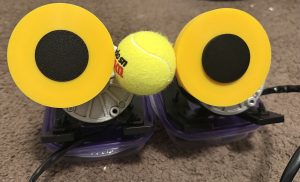
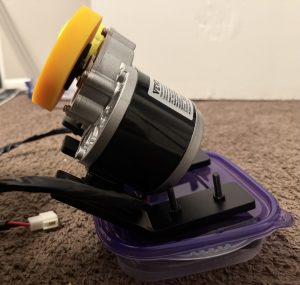
Throughout this week we spent a lot of time preparing for the interim demo. As stated last week, I had some issues with the motor control board we bought last week, so for the demos we used a lower power substitute to simply get the wheels spinning to show for demo. I have ordered a new motor board that when it arrives should fulfill our needs. We are also considering pivoting to using a robot kit for the turning instead of the turret from the suggestion of Tamal, as that will be much faster and more reliable to implement, but we are still doing some research.

Over the next week, once the motor board arrives we hope to start doing some integration with the camera as well as start building our structure now that the pvc has arrived.

In terms of verification and validation, the main tests relating to the motors will simply be running more launch tests once we have the structure finalized and the new motor board arrives. We have already seen in our preliminary tests that the launch seems promising, so once it is finalized and further testing will be able to verify whether or not we can meet the requirements. We will also have to conduct tests on the turning and targeting once everything has been fully integrated.

John’s Status Report for 11/8/2025

This week, I’ve been mostly working on interfacing with the camera and attempting to get depthAI to work. This took much longer than expected because of various integration issues I kept getting. Eventually, I had to abandon my old code and switch to Python, as I had dependency issues that I spent three days and over 15 hours trying to fix. Then I started spending my time attempting to get a Python version of my code up and running, and I am currently in the debug phase. I plan to have a fully functioning CV code by tomorrow for the demo on Monday.

For next week, we will mostly be focusing on the demo, but I plan on cleaning up the CV, potentially revisiting the possibility of doing it in C, while also helping get our launchers’ rotational base working.

Miles’ Status Report for 11/8

This week I have mostly been working on getting the motors working. I spent a lot of the week first getting a proper connection, as the motors came with a very niche connector so I had to make a custom adapter for it. Also, after some more testing we realized that the flipsky motor board we borrowed seems to be dead. We were waiting on a battery charger for a while so we couldn’t fully test the board until recently, but after probing some of the power pins it seems that the board is receiving no power from either USB or the battery. Its possible the board is just bricked and may just need to be reflashed with new firmware, but I think its more likely that there is some component on the board that’s dead. We’ll try more repair efforts next week, but we’ll likely just need a replacement control board, which we still have the budget for. For demo, we plan to use some manual drivers just to get a launch going.

For next week we will mostly be focusing on demo, but we also will get our replacement permanent parts installed and start working on the turning component as well.

Team Status Report for 11/08/2025

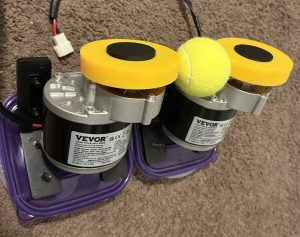
The most significant risks that could jeopardize the success of the project is still the actual launcher mechanism, but it is not as severe as last week since we are already building it. With the 3D printed wheel attachments, 45º angle connectors and screws, PVC pipe/sheet, and putty, we are able to attach the wheels to the axis of the bike motor and use putty for stabilization and strongly attach the motor base at a 45º angle. The PVC pipe is very sturdy, which makes us feel more confident about our structure compared to the 3D printed design. A small risk would be that we are currently using temporary solutions for some parts. The PVC sheet, which acts as our base lid, did not arrive in time this week so we are using a temporary solution to attach the motors and create a distance between them to launch a tennis ball. The motor control board we borrowed from the ECE department is also not working, so a temporary one that has an on and off switch and potentiometer speed control is being used. However, these are mainly used for interim demo and once we have better working parts come in, we are confident in having everything work and integrated as intended. Pictures of current setup are included below.

No changes were made to the existing design of the system. We have updated our new schedule/ghant chart below. We are back on track with our progress after the setback from last week.


Gannt Chart – Interim Demo

Andrew’s Status Report for 11/08/2025

This week I made much more progress on building the launcher mechanism after the new parts arrived due to complications mentioned in the last status report. Specifically, the parts are the 3D printed wheel attachments, 45º angle connectors and screws, PVC pipe, and putty.  The 3D printed wheel attachments fit perfectly in the middle of the wheel, with very high friction such that the wheel does not slide up and down, and attaches smoothly onto the shaft/teeth of the bike motor axis. Since the bike motor has a rounded bolt that extends beyond the teeth, the wheel would wobble a little. I inserted putty into the 3d printed attachment to fix this issue and ensure the wheel spins stably. I connected the bike motor base to four 45º angle connectors with corresponding screws and separately them to the distance of a tennis ball diameter to make sure it can launch it. The PVC sheet that will be used as the lid of the base has not arrived yet, so I stationed the motors on a cardboard box/plastic container lid temporarily for interim demo. I also helped Miles work on the motor control of the launcher. The motor control board borrowed from the ECE department is not working properly and possibly broken, so a new temporary one that has a potentiometer speed control with an on off switch was bought and I helped Miles incorporate it into our project. I would say the launcher mechanism, even though it is not perfect and a few parts are temporary solutions, it is ready for interim demo. In the next few weeks, I am confident that we can easily replace the temporary parts with better and permanent ones that work similarly.

I would say my progress is now back on schedule. After the compilations mentioned last week about 3D printing the structure, I found that buying parts like PVC pipes/sheets and 45º angle connectors instead of 3D printing them made the process more straightforward. The structure is much more stable, something I worried about with 3D printing. My focus can now be more on how to improve the launch of the tennis ball and integrate the different major parts of the project, rather than if physical parts are going to break or not.

Next week, I hope to get started on the base rotation (x-axis) by purchasing gears to attach to the inside of the PVC pipe. I want to help Miles with controlling the stepper motor to rotate the base since the launcher can shoot a tennis ball now, while John works on the CV. Finally, I am going to try to replace the temporary parts with permanent ones and try to maintain or improve the launch of the tennis ball.

John’s Status Report for 11/01/25

All the parts came in this week, and as such, we started orienting the build. We ran into a large issue with our 3D printing plan. We realized that we cannot 3D print our housing unit in one print due to the weight limit of 175g.  This caused us to have to make a few design changes. Specifically, we decided to only 3D print precise portions of our design, such as the gears, and replace the base as well as the support beam in the center of the base with PVC. This will also allow us to make a higher-density print for the gears, ensuring they are more sturdy.

We have fallen behind because we had to wait for parts to come in for our project. Our schedule has been condensed a bit as we now have to put certain software parts of our project, such as the coding and interfacing, ahead in our schedule to free up time later on. As a result, to get back on schedule, I plan to get the camera working with the CV algorithm and hopefully also allow it to send coordinate values to our Pi.

Team Status Report for 11/01/2025

The most significant risk that could jeopardize the success of the project is still the launcher mechanism. We still cannot be entirely sure how well it will launch until a prototype is built. We are working on finalizing a base that will hold the DC motors and tilt it 45º and creating an attachment between the wheels and the motors for spinning. Once these are put together, we already found a library that works with C and Python for the motor control code to launch the tennis ball.

The main change we have made this week is how we plan to assemble the launcher. We realized that an entirely 3D printed design would not be feasible. It is too expensive at around 65 cents per gram, and it cannot print over 175g, which our base weight significantly surpassed.  Instead, we will only be printing the more precise components like the gear mechanisms and the attachment between the wheels and DC motors, and we will be using PVC pipes and sheets for the outer housing and base lid. This will confidently allow for a  stronger foundation at a cheaper price compared to PLA 3D printed material and a guaranteed (and wider if needed) diameter. Other than the material change, we still plan to use the same lid rotation for the actual design, just no longer fully 3D printed. As stated earlier, it is much cheaper to use PVC over PLA 3D printing, which gives us much more flexibility in purchasing other products in case situations similar to this occur down the road.

There are no changes in our schedule. We just need to try complete building the launcher mechanism as soon as possible for the interim demo and integrate other components in (draft CV and motor control code).

Miles’ Status Report for 11/1/25

This week i was mainly working on getting a skeleton of the motor code working as well as working on the launcher structure. We received some of our parts this week, and I was able to get the raspberry pi set up and running and get ssh to it working. I was also working on the 3d printing when we realized we should make a design change, which is described in the team report.

Throughout this next week, we plan to have a skeleton prototype that can at least launch the ball the required distance we want it to for the interim demo.

Andrew’s Status Report for 11/01/2025

All of the parts came in this week (both DC bike motors, battery, and wheels). I was able to start building the launcher mechanism and finalized the design/placement of components such that it would fit and work smoothly once the base is made. I also helped John look over the draft of the Oak-D Pro CV code, which is still the same and just needs to be actually tested. I also helped Miles work with a library that is compatible with C and Python for the motor control code, which is straightforward and should be implemented quickly once the launcher comes together.

I would say my progress is a little behind. The 3D printed base is still not here, and it may not be made since it is too expensive (65 cents per gram) and the 3D printers cannot print anything over 175g (the weight of our base is significantly above this due to our 10″ diameter). As an alternative for the base that will house the DC motors and tilt it 45º, I decided to opt into using wide PVC pipes and sheets instead. This is not only cheaper, but it can guarantee us structural integrity that we were unsure of with 3D printing PLA material. I also discovered that the wheels cannot directly connect to the DC motors’ shafts, which means they cannot spin yet. To fix this issue, I helped Miles 3D print a model that acts as an attachment between the motor and wheels. Once the base is made and the wheel attachments are received, alongside the motor control code already at hand, I believe that the launcher can easily be finalized. I can then test the launched distance and tune the DC motors to the correct RPM, torque, and power to generate the exact exit speed and energy.

Next week, I hope to have the launcher mechanism finished. I hope to have the DC motors attached to the base, wheels connected on and spinning, and the tennis ball being able to actually launch it around 20 feet for the interim demo.