Team Status Report for 10/4

Unfortunately, as we have yet to receive feedback from the design presentation, we weren’t able to make an adjustments to our design plans this week. We did add some items to our BOM, such as power supply units. Because we removed wheels from our BOM, these costs can be easily absorbed into our remaining budget.

Our main risks going forward are centered in the structural section and motor control section. For structure, it’s unclear if our current setup will fully support the gantry weight, but we are planning on mitigating this risk by building and testing it early enough that we have time to add additional supports. For motor control, we may need some more parts or attachments to make the motors function correctly. Again, we are mitigating this issue by finding these flaws as early as next week.

Next week the team will complete the design report, website, and CAD, and will work on motor control, planning, and construction.

Alex’s Status Report for 10/4

I started this week by working on the design presentation slides, updating the requirements and solution slides after I helped the team make some major design changes to the wheels (by removing them). Later in the week, I received most of the parts necessary to start work on controlling the motors. To that end I got the Raspberry Pi working and started wiring the stepper motors and the Arduino/CNC shield. I also ordered a few more parts from our BOM that would continue to help me get this all set up.

This puts me a bit behind schedule, but I remain confident that I’ll be able to fairly easily catch back up, as there is some leeway in getting the motor control to work.

Next week, I will work on the design document to help fully flesh out our plan. I also hope to finish setting up and evaluating the motors to make sure we can control them well using the Pi and Arduino.

Ethan’s Status Report for 10/4

This week was a slower week in terms of personal progress, due to a variety of factors. One such factor was that I was expecting feedback on our design presentation to incorporate into my structural design and design report, but I have not received feedback yet. As a result, this has caused some delay in my part ordering, structural design changes, and design report writing.

Despite those challenges I was able to start some work on two of the three tasks above. Firstly, I was able to put in some part orders for parts for the gantry. The gantry is an existing design (https://www.instructables.com/4xiDraw/) that we are going to attach to our uniquely designed stand. Therefore, the parts needed are very unlikely to change. Secondly, I was able to start work on the design report by working on the sections I have been in charge of thus far: the structure. This includes the implementation plan as well as the overall design. This work was minimal as I don’t want to get too far without feedback from the course staff after our presentation.

Looking forward to next week, I hope to get the material I ordered and start the assembly of the gantry. This includes planning out 3D printed parts and fully fleshing out the structure implementation plan which goes along with finishing the design report. This differs a little bit from our original task distribution which had me working more on the software side. However, as the project has progressed and I’ve done most of the work on the structure, I have been leading that portion and Andrew has been working more on the software.

Andrew’s Status Report for 9/27

At the beginning of the week, I focused on the project website. I worked on setting it up and started developing the upload functionality so that files can be submitted through the site. I got the upload feature to work so it should be ready to connect to the Raspberry Pi once testing for image to vectors begins.

I will be presenting for the team on Monday, so later in the week, I shifted towards preparing for our upcoming presentation. I worked on refining the slides and practicing my talking points. I also reviewed the overall presentation to make sure it flows smoothly.

I am currently on schedule with my tasks. Next week, I plan to test the upload feature with the Raspberry Pi and continue expanding the website with project content. I also plan to incorporate feedback from the presentation into our design work. When the motors arrive, I plan on also helping out with the integration.

Alex’s Status Report for 9/27

This week I focused mainly on the design of our robot. I researched parts to help Ethan with his CAD design and helped make decisions on the form of our project. I worked with the BOM to fit everything we could within budget constraints. I also ordered  some of the preliminary parts, like the motors, Pi, and necessary pieces to make them work. I started the setup of the Pi, but due to the lack of an SD card, it couldn’t be completed. Finally, I helped work on the design slides for our presentation next week.

This is slightly behind schedule, as I had planned on gaining access to motors this week, but I worked ahead a little on other parts, so I should get back on track easily. Next week I should have a full setup to begin working with the motors. I plan on setting up the motor control software suite we planned on using, and verifying that everything is functional.

Team Status Report for 9/27

After last week’s presentations, we wanted to incorporate the some of the feedback we received. Firstly, we decided that some of our requirements we somewhat unreasonable such as having 95% accuracy and precision for drawing strokes. We reevaluated some of these requirements and decided on figures that were reasonable and justifiable.

Next we finalized our bill of materials (BOM) and while doing so we realized that we were going to be overbudget. The primary source of our spending is on structural and mechanical parts such as motors, rails, and wheels. In order to maintain the most functionality we decided to remove the wheels and the automatic horizontal adjustment functionality from our design for the following reasons:

  1. We plan to showcase our design on the moveable whiteboards found in the 1300 hallway of Hamershlag Hall. These boards are much taller than they are wide. Therefore during our final presentation it would be unlikely that we’d be able to showcase the automatic horizontal movement.
  2. Re-adding the wheels/horizontal movement would be a lot easier than trying to re-add rails/vertical movement. In the case where we end up under budget, it would be impossible to add the rails at a later date. However, wheels could be added later as they would be attached to the existing structure with only minimal changes.

Our final change this week was ditching the ultra sonic sensors used for dynamic dimension allotment. We decided that adding the sensors would be too bulky and a better alternative could be a basic monochrome camera which detects lines drawn by the user as bounds. However, we are still determining if this idea is worth implementing now that we no longer have horizontal functionality.

Looking toward next week, we plan to work on the following:

  • Finish the website where the user will upload their PDF
  • Get feedback from the Design Presentation to incorporate into our requirements and structure
  • Place the remaining orders for materials on our BOM

Below are our answers to the questions outlined on Status Report 2:

A was written by Andrew
Our project is designed with user safety in mind. Since it involves motors and other moving parts on the gantry system, we are ensuring that those components are shielded or enclosed to prevent accidental injury during operation. The system will be designed so that users do not need to physically interact with the gantry once it begins drawing, minimizing the risk of harm.  Our project will be used for teaching, presenting, and collaborating. It reduces the time and effort required to manually copy diagrams onto a whiteboard which makes tasks less tedious and more reliable. It also gives users the chance for make quick edits. From the welfare perspective, this contributes to user well-being by streamlining preparation and letting people focus on the task at hand such as teaching rather than on repetitive manual work.

B was written by Alex

The robot particularly helps support teachers and students by automating the whiteboard writing process. This could help support underfunded schools by giving them access to a technology similar to smartboards or projectors that they may be unable to afford. Its a mostly lower cost design that could be used throughout a building. These underfunded schools are often home to communities that are often underserved or underrepresented. It can also help aid in communication, as the whiteboard medium is one of collaboration, and this device would only make that easier.

C was written by Ethan.
We designed our project to be customizable and usable anywhere. Specifically we were targeting school teachers. This could have economic implications as we envisioned our project to be used on any type of whiteboard. Therefore schools would only need one gantry system that could be shared in the building. This would ultimately save money in schools since teachers would be more productive and thus a higher percentage of their salary would be spent on teaching. This could have a similar economic impact in other industries if used before meetings to save the setup time for the presenter.
Ethan’s Status Report for 9/27

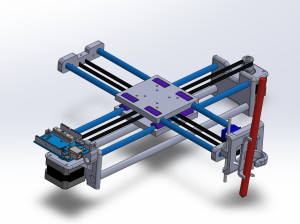
This week I was mostly focused on making the computer aided design (CAD) for the structure of our gantry. We are using an existing gantry design (https://www.instructables.com/4xiDraw/), but we need to create our own structure design so that our gantry is portable and has the capability to raise and lower.

Shown below is the existing gantry.


From our original BOM from last week, I created the below preliminary model.


However, upon updating our BOM during the middle of the week with extra materials that we forgot, we realized that we were over budget and opted to remove the wheels from our original design for reasons outlined in the Team Status Report for 9/27. This led us to our current design shown below.

Looking forward to next week, I look to gain feedback on the structure design during our Design Presentation and incorporate it into the next and final version of the CAD model. Then when the CAD is finalized I look to order the parts and start 3D printing gantry parts and cutting the ordered parts to size.

Team Status Report for 9/20

This week was our first full week working on our new project direction after pivoting from our original idea of building an automated stroller last week. The change meant we had to spend a good amount of time brainstorming. Once we had the the idea, we worked together to define the requirements as well creating the proposal presentation together. The presentation itself went well, and it gave us a solid chance to talk through the system as a team.

Since we changed directions last week, we were a bit behind where we had liked to be. Despite this, we worked efficiently, and are planning to lock down the Bill of Materials quickly so parts can be ordered.

Plans for Next Week:

  • Finalize the BOM and place part orders.
  • Start CAD modeling for the gantry.
  • Build an initial upload page for file submissions.
  • Set up the Raspberry Pi and Arduino so they’re ready for hardware testing as soon as parts arrive.

Even though the pivot put us under some pressure, this week felt productive. We came together on the new idea, got through the proposal presentation, and set ourselves up to move forward.

Andrew’s Status Report for 9/20

At the beginning of the week, I worked on the presentation slides. Specifically, I created the slides for the use case, overall solution, and testing plan. I also helped review the final edits of the overall presentation to ensure consistency across the team’s sections.

Later in the week, I shifted my focus to the software side. I began looking into how we can implement the website for PDF upload, which will serve as the interface for sending files to the system. I researched potential frameworks like Flask and Node.js and mapped out the basic workflow for how an uploaded file would be stored and then processed by the controller.

Next week, I plan to start building an upload page so the team can test the process. If time allows, I will set up the backend so it’s ready to connect with the Raspberry Pi once hardware testing begins.

Alex’s Status Report for 9/20

Early this week and at the end of last, I worked on the presentation slides. Specifically I did the requirements, technical challenges, and formulated the schedule. Later in the week I worked with Ethan to create the bill of materials. He focused mostly on the small gantry, so I confirmed his part list and then worked on the rest of the system. I ended with a list of parts that I’m sure we will need, though there are still some more that we need more testing to confirm on.

We remain on the planned schedule, and assuming we get these parts ordered shortly, we should be on target.

Next week, I plan on setting up the Raspberry Pi and Arduino so they are ready for us to use them. Depending on when the motors arrive, I may also start on configuring them to work properly with the Arduino.