Alex’s Status Report for 11/1

This week I continued working with the motors. Since only the gantry motors need to be controlled by GRBL, I researched methods to control the other 3 stepper motors. Then, based on that research, I started testing further motor control methods. Later in the week we started building the gantry but then realized some of the parts were mismatched in sizes. I ordered some PLA printer filament so we could reprint those incorrect parts and continue building.

Next week we should be able to fully build the gantry and start integrating full software pipeline with motor control before the early demo. This week I continue to remain on schedule and should be all set for next week to go well.

Alex’s Status Report for 10/25

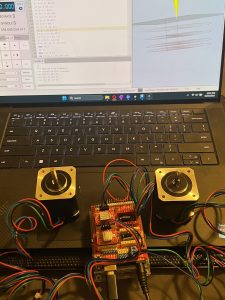
This week was largely successful in terms of my work. After finally getting all of the different pieces required to get the motors working, I was able to started with the motors. I assembled the hardware together, and I was able to get GRBL software on the Arduino connected to software on my computer.  I ran some tests to verify that the parts still worked, and everything appeared to be in order. I also helped Ethan procure some 3D printed parts and was able to get them delivered to me today (10/25).

This week was a week of returning to schedule. I blasted through my backlog of work and I believe I’m currently on schedule. Next week, I hope to help finalize the smaller gantry construction so I can begin testing the motors in their final configuration. As we near partial completion of this section of the project, I also plan on ordering more parts as we confirm exactly what we need.

Andrew’s Status Report for 10/25

I shifted my focus from software side to work on building the gantry in preparation for the upcoming demo. Ethan and I worked mainly on laser cutting. We ran into some issues on that end since the laser cutters we were using turned out to be faulty. That obstacle aside, we finished laser cutting all the pieces we need to build the gantry. We plan on finishing the build early this coming week. Once that is done, we can start testing how uploaded files translate into actual motion on the gantry.

I made some progress on the flash website. I added the website feedback so users can see the upload and conversion status. The goal next week would be starting to connecting everything from upload to sending commands.

I am a little less behind schedule than last week. I am confident that once we the build gantry running with the G-code, we will be in a good spot.

Ethan’s Status Report for 10/25

Once again, I was not able to get as much done as I wanted this week. My primary goal was to fully construct the gantry system, however I ran in to a few obstacles. The primary setback was finding out that 3D printing some gantry at Techspark was expensive and that I needed to find an alternative. I was able to pivot and laser cut some of the 3D printed pieces using plywood in the later part of the week (with the help of Andrew), but not after using a faulty laser cutter, wasting material and budget. Additionally, some of the parts are required to be 3D printed so Alex and I were able to find a friend who was willing to 3D print the parts for us for no cost, but they would not be ready until Sunday (10/26) at the earliest.

At this point, I am behind schedule. It was planned that the construction of the gantry system would be complete this week. However, assuming I can get the 3D printed parts early next week, I think it is possible to complete the gantry system construction and move on to the software side of the project while beginning to purchase the base and structure that will house the gantry.

Team Status Report for 10/25

This week was all about overcoming challenges. We finalized the pre-fabricated cart that we will use for the base of our structure. That cart is not perfect due to our budget constraints and will need some modifications such as removing the upper cage and creating attachments for the vertical T-slot beams. Additionally, the original plan to 3D print many gantry parts was changed due to budget constraints. The team opted to go for laser cut parts instead which took longer than it should have to get cut due to many attempts on a faulty laser cutter.

In more positive news, all of the parts for the motors (power supply, steppers, etc) have arrived and code has started being written. We hope to have the motors functional for the gantry system when it is built, which hopefully this week. This would allow us to focus on the pathing and conversion scripts. Our plan for the interim demo is to showcase the fully working gantry system with some standalone horizontal and vertical movement and begin integration after.

Other than finalizing the cart, there are no large design changes this week. We are a little behind our schedule, but if the gantry is able to come online this upcoming week, we think we are still in a decent spot to have our goal for the interim demo achieved.

Andrew’s Status Report for 10/18

This week I continued to work with SpirePDF. I was having trouble with the parsing and the conversion of the uploaded PDFs. After testing it to see how well it could handle different diagrams and texts, some files resulted in giving inconsistent SVG outputs. I have been exploring other possible workarounds and alternative tools that we can maybe use in the future. The challenge this coming week would be to get the pipeline fully working from the web upload to the G-code generation.

The goal next week would be starting to connecting everything from upload to sending commands. I’ll also work on improving the website feedback so users can see upload and conversion status in real time. Once that’s working, we can start doing full integration tests with the hardware.

I’m a little behind schedule due to some parser troubleshooting, but with the design work settled, I should be able to catch up next week.

Alex’s Status Report for 10/18

This week was mainly focused on system design. I spent lot of my time attempting to integrate feedback from the design presentation, and incorporate that into the design document. One such example is the wheels that we now need to put back in the design.  I did a lot of research and found some possible implementations that would keep us barely in budget. I personally worked on the system architecture and system implementation sections of the document. This meant that I had to spend a lot of time figuring out everything we hadn’t quite gotten to yet, meaning I had a lot less time to work on the motors. I also ordered a lot of the miscellaneous pieces for the gantry system.

Next week will be a big one for me. I now have all of the parts and pieces I need to get the motors on the gantry working, so I’ll spend most of the week working on those. I need to get the Arduino talking to the motors and moving them accurately, and controlling that movement with the Raspberry Pi.

I’m a little behind schedule due to the backlog of design work, but with a forgiving schedule, I should be able to get back on track quickly.

Team Status Report for 10/18

This week’s focus for us was to incorporate the feedback we received from the design presentation. We decided to refine our system design. The significant thing that we decided to change was adding the wheels back into our gantry design so our gantry can move horizontally. Before this week, we had taken out the wheels since we had a budget constraint. After some research, we potentially found a more affordable option by using a premade wagon base.

Progress was made on both software and hardware this week as well. On the software side, we continued to work on the file upload and parsing. We were able to continue testing the PDF conversion to G-code. On the hardware side, the part orders were finalized and  we began preparing for motor setup and control testing. Most of the ordered components have arrived. As a result, next week will focus heavily on system integration.

We plan to get the motors running. We will also begin integrating the software upload with the hardware control system to start full end-to-end testing. While we’re slightly behind schedule due to the design revisions, but hopefully the updated plan puts us in good position to catch up quickly.

Part A was written by Alex

Our project has the potential to create impact on a global scale. For one, it has potential for use in any academic institution around the world. The technology would be easily adaptable and can theoretically transcribe any PDF, meaning regardless of language or location, it would still work. It is also cheaper and more transportable than the systems it replaces, like classroom projectors. It also integrates well with whiteboards or chalkboards, which are common around the world. We also hope to make it easy to use, meaning anyone, even those with limited technical knowledge should be able to make use of it.

Part B was written by Ethan

The project at a glance does not seem to have any major cultural considerations, but even at a small scale any sort of automation can have a cultural impact as to some extent, someone’s job is being done by a machine. Our intentions with the project is not to automate someone’s job, but instead be a tool to help teachers, presenters, and companies focus on the important parts involving putting text or diagrams on a whiteboard, getting the their point across and having the content being easily editable.

From a larger perspective this project strengthens the wider movement of automation in many aspects of industry. The subject of automation is still quite divisive to many, and our project further encourages using machines and to an extent, robots, in front of a very impressionable group, children.

Part C was written by Andrew

From an environmental standpoint, our gantry will be drawing directly on whiteboards and other reusable surfaces, in classrooms and meeting spaces, so that means there’s no need to use paper copies of diagrams, which helps reduce paper waste over time. The hardware also runs on low power with the Raspberry Pi and Arduino using potentially less energy than a projector would. We also will be 3D printing some of our own parts in Techspark which helps limit shipping and packaging waste.
Ethan’s Status Report for 10/18

This week was once again a slower week in terms of personal progress due to being right after the design presentations. However, the feedback from the presentations was valuable. This motivated the work I did this week which included ordering of gantry parts, ideating a new, less expensive wheel based system for the gantry stand, and completing the Design Report.

Previously the team scrapped the wheels to due the cost for our original design being too high, but the new design uses a pre-fabed, low cost metal wagon that we are going to modify (more details in this weeks team report). Therefore, I will have to modify the CAD to account for the changes to the design once we get them finalized and approved by the teaching staff.

This sets me up to start 3D printing parts and assembling the gantry the week after break. Additionally, with the changes to the gantry stand, I may start ordering the stand parts and modifying the CAD if the feedback from the teaching staff about the change is positive.

Andrew’s Status Report for 10/04

This week, I implemented the file upload functionality for our Flask web interface, which is currently hosted locally on the Raspberry Pi. The site can now accept PDF uploads for processing. I also began experimenting with SpirePDF for parsing and converting PDFs into vector formats that will later feed into our toolpath generation pipeline.

By the end of next week, I plan to integrate the PDF parsing results with the SVG-to-G-code conversion flow. I’ll also work on improving the front-end feedback (status messages after upload) and maybe even look up some deployment options such as Gunicorn for non-local hosting.

I realized SpirePDF has some limitations with complex image PDFs, so I will need to do additional testing. This might set me a little behind schedule.