Nick’s Status Report for 12/06

Accomplishments

This week I worked extensively with Caitlyn and Enrique on performing user testing, and fine tuning our control scheme. I also re-soldered the Kontroller board a couple of times as weak joints broke during testing. Overall, I’ve strengthned many of the solder joints on our finger IMU which should allow for stringent use during our demo.

Schedule

We have completed our MVP.

Next Steps

We are refining our project experience as much as possible, tuning according to user feedback.

Nick’s Status Report for 11/22

Accomplishments

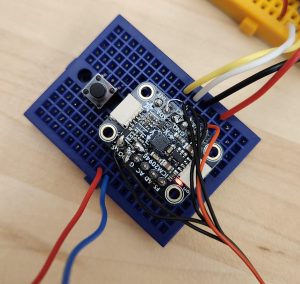
This week I completed soldering of the Glove PCB. Specifically, I soldered the finger PCB to the connector coming from the Glove PCB. This now lets us perform tests with the completed glove controller. Below is an image of the fully-soldered IMU. We are still keeping the IMU on our breadboard for testing right now.

Progress/Schedule

We are on track given our updated schedule from our interim demo. We are making good progress towards streamlining our controller and solidifying our control scheme.

Next Steps

Next week I will be working collaboratively with the rest of the team to make improvements to our control scheme and to close the loop between Kar and Kontroller.

As you’ve designed, implemented and debugged your project, what new tools or new knowledge did you find it necessary to learn to be able to accomplish these tasks? What learning strategies did you use to acquire this new knowledge?

A new manufacturing technique that I had to learn was how to solder SMT components to a PCB without a stencil, and where the component pins were on the bottom of the IC. This required me to watch a YouTube video on the topic, which demonstrated a technique of mixing flux and solder paste together on the board before using a hot air gun to solder. I successfully used this technique to solder our buck converter to the Kar PCB. Additionally, I had to learn more PCB rework skills for this project, due to the manufacturing issues with our PCBs. This was mostly self-taught, as I messed around with techniques of sticking wires and components to the boards until they worked properly.

Nick’s Status Report for 11/15

Accomplishments

This week I supported the interim demo by maintaining the Kar’s electronic systems and ensured that the Kar was properly setup for demo. This involved ensuring that the batteries were properly charged between demo sessions, and that the PCB was properly mounted to the Kar chassis. Additionally, after our demos I added an IMU to our Kar so that we can complete our haptic feedback loop between the Kar and the Kontroller.

Progress/Schedule

We are on schedule for the most part. I was hoping to attach the finger IMU sensor to the Kontroller this week, but was not able to. However, the lack of progress on this goal was cancelled out by successfully adding the Kar IMU.

Next Steps

Next week I will be attaching the finger IMU sensor to the glove PCB so that we can begin the transition from our breadboard control system to our final control system.

Nick’s Status Report for 11/08

Accomplishments

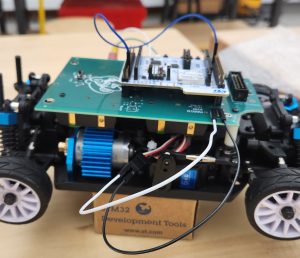
This week I completed soldering of the Kar PCB, and the Glove PCB. I also integrated the Kar PCB with the Kar itself, and worked with the team to perform our first test where the Kar moved on the ground under its own power. There were a couple of integration issues to sort out, such as the electronic speed controller for our primary motor backdriving our power system on the Kar, but otherwise integration was a relatively smooth process. An image of the Kar PCB integrated with the Kar can be seen below:

Progress/Schedule

Everything PCB-wise is going to schedule. We have a working Kar PCB prepared for our interim demo, and will be using the time we have from now until the final demo to refine our control systems and product in general.

Next Steps

Next week I will be working on supporting the interim demo, and keeping track of electrical faults as they come up. Additionally, I will need to attach the finger sensor to the glove PCB at some point in the week.

Nick’s Status Report for 11/1

Accomplishments

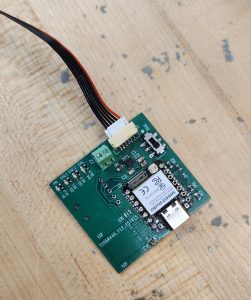
This week I practically completely finished assembly of the glove PCB. The only components which are missing are the haptic motor driver, which still needs to be acquired from Ideate; the LDO output capacitor, which ran out of stock on Digikey and will likely be acquired from Roboclub; and the LDO itself, as we identified a manufacturing issue that ensures we need to do extra work in order to attach the LDO to the PCB. A picture of the PCB soldering progress can be seen below. We also realized this week that due to an ordering error, we did not order all of the components needed for our Kar PCB, so these extra components have been ordered.

Progress/Schedule

PCB assembly is going according to schedule. The Kar PCB missing components would have led to a setback if it had been noticed later, but it was noticed promptly at the beginning of last week which means we will be able to smoothly transition between assembly of the glove PCB and assembly of the Kar PCB.

Next Steps

I will finish the assembly of the glove PCB tomorrow (11/1), and assuming the Kar PCB components arrive on Monday I will begin and complete the Kar PCB assembly leading up to the interim demo.


Nick’s Status Report for 10/25

Accomplishments

This last week I began assembly of our PCBs. I was a little delayed in getting started on assembling them, as the Digikey order did not arrive until Thursday. The glove PCB is around 50% completed, and after I finish it I will move onto the Kar PCB.

Progress/Schedule

Given the new re-arranged schedule the team came up with (discussed in last week’s team report, I am still on schedule. I hope to finish all of the assembly for the PCBs by next weekend so that there is plenty of time to test software on our actual finalized hardware before the interim demo.

Next Steps

I will continue to assemble, and hopefully finalize assembly of, our PCBs in the coming week.

Nick’s Status Report for 10/18

Accomplishments

These least two weeks (the week before break and the break week), I finally sent out the orders for our PCBs to be manufactured, and then additionally sent out orders for all of the surface mounted PCB components from Digikey for each PCB. The original plan was to have both PCBs manufactured and assembled (having components placed for us), by PCBway. However, with shipping restrictions caused by tariffs we were forced to switch to JLCPCB. Therefore, I made changes to our PCB designs so that we could get cheap manufacturing from JLCPCB, but found out that with the new increase in tariff percentages getting assembly for our Kar PCB alone would incur $100 of purely tariff cost, which would wipe out the rest of our budget. As such, I changed the orders such that we are now purely paying for PCB manufacturing, and I will now perform all the assembly for the PCBs myself.

Progress/Schedule

The requirement for me to assemble the PCBs myself will undoubtedly have impacts on the schedule, not to mention the amount of delays encountered in actually ordering them. The one saving grace is that due to the PCB fabs not performing assembly, the PCBs will be delivered much quicker, meaning I can start assembly quite soon. Regardless, this will likely wipe out the time I had allocated for slack in my personal schedule.

Next Steps

Our PCBs will be delivered by EOD this coming Wednesday. As such, my plan for the coming week is to perform assembly on the PCBs and at minimum finish assembly for the glove PCB, and the finger attachment with the Adafruit board.

Nick’s Status Report for 10/04

Accomplishments

This week I first modified the Kar PCB shape to match the one that originally ships with the Kar. Now they have virtually identical footprints and mounting holes, meaning ours should be able to slot right onto the Kar. I also worked on getting quotes from various PCB manufacturers for the manufacturing and assembly of our custom PCBs. This led to me making many small adjustments to the PCB designs to hopefully secure lower quote prices, as we only have around $300 of our budget left. Currently, the quotes from the manufacturers total around $210, but we expect that to increase once the PCB designs and BOMs are reviewed; especially with the impact of current tariffs. As such, if the final quotes for the PCBs are too high I will make a couple more optimizations and/or forego assembly on the boards to drive the prices even lower, at the cost of extra bringup work in a couple of weeks. I also soldered some sensors which the team scavenged from various sources around campus for breadboard-level testing.

Progress/Schedule

The PCB ordering process is a little behind schedule due to delays in waiting for finalized quotes, but if they are received early within the next week I believe this to have a negligible impact on overall progress.

Next Steps

This coming week I will work on finalizing the quotes for the PCBs and getting them ordered. As stated, if the costs are too high, I will instead work on PCB reworks to bring manufacturing costs down: one proposed option is mounting our nucleo debug board on our Kar PCB to vastly simplify the PCB manufacturing requirements. Otherwise, I will be working with the rest of the team on breadboard-level implementation and debug testing in preparation for deployment of our code onto our PCBs.

Nick’s Status Report for 9/27

Accomplishments

This week I worked on completing the preliminary layouts for all of the boards. With our chosen design for our hand controls, we were able to solidify our IMU choices and get back on track for our board design schedule. Now that we have decided to use two IMUs for the hand controller, two boards were required for the glove: one for the primary microcontroller on the back of the hand, and one for the IMU on the fingers. This required some extra work like selecting connectors and a cable for connecting between the two boards, so that the power, ground and SPI lines could reach the IMU. The one bottleneck for board design is that the Kar PCB sizing is still a little bit uncertain, as we do not yet know where the holes for the Kar PCB will be. This will be solidified when the Kar arrives and is measured; it has already been ordered.

Progress/Schedule

Progress is essentially back on schedule, although ideally all the layouts would have been done by now. However, adding holes to the PCB should be a very quick process once the Kar arrives.

Next Steps

This coming week I will be working on purchasing many of the components we need for the boards, as well as potentially putting in orders for the PCBs + assembly as well. I will need to see what the order process is for boards in order to do this.

Nick’s Status Report for 9/20

Accomplishments

This week I worked on completing the preliminary schematic for the both the glove and the kar. This primarily involved doing component selection for the different aspects of each system. For example, the kar needed a motor controller IC for the BDC motors on the COTS RC body we are purchasing. For this, I selected TI’s DRV8242-Q1, as it does all the required current sensing and has all the needed H-bridge circuitry internally. However, this necessitated the use of a level-shifter IC, as the DRV84242 has a 5V logic level and the STM32WB55 we are using only supports 3.3V logic levels. In terms of power supply, I also had to select voltage regulators as the battery inputs we are using provideĀ  8.4V and the motor controller and the STM32 will need 5V and 3.3V as described. I decided to use a buck converter to drop from 8.4V to 5V for the greater efficiency at the higher motor driver amperage, and then a 5V to 3.3V LDO for providing a low noise input for the STM32. The ESP32 needs to step 3.7V down to 3.3V. At low amperage, the 5V to 3.3V LDO I have selected (LM3940) has a low enough dropout voltage that it can effectively regulate for the ESP32 as well, which is convenient. After performing component selection, creating the schematic in Altium for all the components was relatively straightforward. The one component I have not yet selected + put in schematic is the IMU, as the team is still discussing regarding IMU selection and/or the usage of a flex sensor in the control glove.

Progress/Schedule

Due to not having selected an IMU, my progress is slightly behind schedule. However, I am confident I can quickly select the IMU and put it in schematic at the start of next week, and continue with my tasks as normal.

Next Steps

As described, this coming week I will be selecting the IMU and doing the schematic for it to catch up to the schedule. Additionally, I will start work on the layout for the PCBs as described in our gantt chart. By next Saturday, I should have preliminary schematic and layout prepared for review.